A Historical Self-Study by the Reparations Commission of the Episcopal Diocese of New Jersey
Saturday, October 3, 2026
"Anglican Slavery in New Jersey" Reviewed in AEH Journal by Rev. Dr. Valerie Bailey
Thursday, October 1, 2026
Correspondence Following the Black Caucus Response to the Steinke Report, June-July 1997
Following the wide circulation of the Black Caucus response[1] to the Steinke Report[2] on Bishop Doss’ behavior during his episcopate, which included both accusations of racism and a recommitment to acting in love toward diocesan leadership accused of racism, the Caucus reported receiving a high volume of correspondence. On July 9, 1997 the Caucus wrote publicly to “Friends” regarding this correspondence and included in their letter a facsimile of a letter they had received from the Rev. Dean Henry of Christ Church, Middletown (sent on June 25, 1997), along with the response they had sent to him on July 2, 1997. It is likely that both the letter of July 9 and that of July 2 were authored by the Rev. Cn. Dr. Leroy Lyons of St. Mark’s Episcopal Church, Plainfield, New Jersey.
No doubt the letter from the Rev. Henry is included because it provides an example of an embarrassingly poor response from a white priest supportive of Doss, and critical of the Black Caucus. Henry’s letter is short, and ostensibly polite, but clearly alleges that the Black Caucus includes many of those “who are not truly repentant” and who “frustrate the work of the Holy Spirit.” Henry also suggests that the members of the Black Caucus need to exhibit less “willfulness.” Incredibly, though praising the exegesis exhibited in the Black Caucus response to the Steinke Report, he shows such a lack of familiarity with the letter to Philemon that he misspells Onesimus’ name several times. The glaring issues with his missive do not go unanswered.
Writing for the Black Caucus, Lyons similarly strikes an ostensibly polite tone, but highlights Henry’s apparent lack of familiarity with the biblical text,[3] and disputes both Henry’s argument and his allegations of sinfulness. Lyons returns to Philemon to correct Henry and to insist that neither Onesimus nor the Black Caucus acted sinfully, or “rebelliously.” Lyons insists both on the commitment to agapÄ“ that the Black Caucus maintains, and the onus of responsibility on Bishop Doss to exhibit this quality himself.
The correspondence indicates both the degree of unexamined racism that existed in white priests in the diocese at the time, the readiness with which such priests supported a racist bishop and criticized those attempting to hold him accountable, and the lengths to which the Black Caucus went to try to educate their white Episcopalian colleagues. The correspondence[4] is provided in full below, courtesy of the Rev. Cn. Dr. Leroy Lyons.
Reparations Commission Research Historian
Episcopal Diocese of New Jersey
[1] See “A Response to the Steinke Report From the Black Caucus, The Diocese of New Jersey,” June 14, 1997. MSS held at the private archive of the Rev. Cn. Dr. Leroy Lyons, Plainfield, New Jersey. See also Jolyon G. R. Pruszinski, “The Black Caucus Responds to the Steinke Report on Shortcomings of Doss’ Episcopal, June 14, 1997,” DNJRJR (August 2, 2026): https://dionj-racialjusticereview.blogspot.com/2026/08/the-black-caucus-responds-to-steinke.html.
[2] A report from an outside consultant who investigated allegations of problematic behavior on the part of Bishop Doss, delivered to the diocese on May 16, 1997. See David M. Herszenhorn, “An Embattled Episcopal Bishop; His Ouster Is Sought by Leaders of the New Jersey Diocese,” New York Times (December 7, 1997): Section 1, page 45. See also Pruszinski, “The Black Caucus Responds to the Steinke Report on Shortcomings of Doss’ Episcopal, June 14, 1997.”
[3] A text on which Lyons wrote his doctoral dissertation.
[4] It includes a Letter from “The members of the Black Caucus” to “Friends,” July 9, `1997, which
appends the following letters: Letter from The Rev. Dean Henry to The Black Caucus, June 25, 1997; and Letter from “Members of the Black Caucus” to The Rev. Dean Henry, July 2, 1997. MSS held at the private archive of the Rev. Cn. Dr. Leroy Lyons, Plainfield, New Jersey.
Wednesday, September 9, 2026
EVENT: "Lamentation" An Exhibit of Paintings by Jane Otto, with an Artist Talk on Reparations, September 23, 2026
Tuesday, September 8, 2026
The Rev. Kenneth E. MacDonald Rejects the Levittown Project before the Diocesan Board of Missions – Dec. 9, 1958
After a series of less formal protests of the diocesan collaboration with the racist Levitt corporation, the Vestry of St. Augustine’s, Atlantic City, and their priest the Rev. Kenneth E. MacDonald submitted formal written protests: St. Augustine’s to the Treasurer of the Diocese, and MacDonald’s to the Board of Missions. MacDonald’s was titled “A Commentary on a proposal to erect a Church at Levittown,” and he delivered it orally and in writing in the meeting held on December 9, 1958.
![]() |
| The conclusion of the Rev. MacDonald's "Commentary," December 9, 1958 (Courtesy of the Diocese of New Jersey) |
He claimed that he and his vestry had not protested more vocally earlier, because he found it hard to believe that the Bishop would cooperate with founding a church in an all-white development when the diocesan convention had formally disavowed segregation in 1955. Apparently, all of Banyard’s prior statements intimating his unwillingness to cooperate with the segregation plans of the Levitt corporation were undone when he admitted at a fall 1958 clergy conference that he was going to accept the gift of land even though Levitt remained unmoved regarding his refusal to sell homes to Black people. MacDonald insisted that if Levitt was unmoved that the church would be de facto segregated, however else it might be spoken of as “integrated” by falling under the aegis of the diocese. Under such a situation MacDonald stated that “If Negroes may not reside there, then the possibility of integration is nullified.” The final passages of MacDonald’s statement are deeply moving and deserve to be quoted in full. He wrote:
My personal opinion, my dear Bishop, is that you will be making a mistake if you accept this property on a stated segregated basis. Your honest assurances of your opposition to the principle of segregation notwithstanding. I sincerely hope that my stand on this matter, my dear Bishop, will not be a source of irritation to you, but in the words of my Vestry, I cannot in good conscience support a proposal, which, in the final analysis will tend to defeat the stated objections of the Diocese of New Jersey. But someone may say: “Will the Church not err in failing to provide pastoral care to those of our Church in that area”? I would reply that Levittown is adjacent to the city of Burlington which has two spacious Episcopal edifices and available resident Priests. I would not be impressed if told that some Protestant Churches are queuing up to accept mr Levit’s [sic] charity. Our Church has never had to look over its shoulders for spiritual or moral guidance from other Churches. My considered opinion is, my dear Bishop, that if for an important principle our Church should take a firm stand and shun a material advantage for such a principle, then in the years to come Churchmen and the residents of New Jersey may very well say, “This was indeed her finest hour”. Thank you sir.
From this episode it becomes clear that the “stated objectives of the Diocese of New Jersey,” as MacDonald refers to them, were in fact misleading. As I have previously written,[1] though the ostensible policy of the diocese was “integration”, in fact the true intent of the policy on the part of the Bishop was to close Black churches, but to allow all-white churches to persist as long as they were called “integrated” in name. The facts of the Levittown project make this abundantly clear.
Unfortunately, Banyard and the diocese did not in fact heed MacDonald’s impassioned and principled protest, the full text[2] of which may be found below. The Church did not “shun a material advantage for such a principle” but rather chose to accept a “material advantage” from the racist Levitt corporation at the expense of principle. It was not “her finest hour.”
Jolyon G. R. Pruszinski, Ph.D.
Reparations Commission Research Historian
Episcopal Diocese of New Jersey
[1] Jolyon G. R. Pruszinski, "Banyard's Move to 'Integrate' Was Really Just a Push to End Black Churches," DNJRJR (July 1, 2026): https://dionj-racialjusticereview.blogspot.com/2026/07/bishop-banyards-move-to-integrate-was.html.
[2] Kenneth E. MacDonald, “A Commentary on a proposal to erect a Church at Levittown,” delivered December 9, 1958 to the Diocese of New Jersey Board of Missions. Courtesy of the Diocese of New Jersey. MSS held at Diocese of New Jersey archives, Trenton, NJ.
Monday, September 7, 2026
A Fawning “Thank You” and No Sign of “Taking a Vigorous Stand Against Any Segregation”: A Letter from Bishop Banyard to William J. Levitt, September 11, 1958
![]() |
| "William J. Levitt in 1951" (Fuel Oil & Oil Heat 1954-11: Vol. 13 Iss. 11, public domain) |
After having solicited the Levitt Corporation for a donation of land to build an Episcopal Church in its new, all-white development in Levittown, NJ,[1] receiving a favorable response,[2] and taking the necessary steps to commit the diocese to the project,[3] Bishop Banyard wrote to William J. Levitt thanking him for the donation.[4] Months earlier, national newspapers had prominently reported Levitt’s anti-Black policy for home sales,[5] and Banyard was warned about it by many members of his diocese.[6] At the time he made a number of conflicting statements on the subject, all aimed at allaying concerns over the collaboration. He did, however, on multiple occasions[7] claim that he would bring the matter up to protest the policy, insisting that he was "taking a vigorous stand against any segregation."[8] He claimed to have mentioned it to VPs at the corporation,[9] but clearly had not done so in a way that would jeopardize the collaboration. And as can be seen from his “Thank you” note to Levitt, it does not appear that he ever brought the matter to him directly. Rather, Banyard praises the all-white development as “wonderful” and fawningly thanks Levitt for his “magnificent gift.” Here we can clearly see that Banyard ignored concerns over justice with the goal of benefitting the diocese financially. In so doing he allowed the reputation of the Episcopal Church to provide moral cover for the anti-Black policy of the Levitt Corporation. The letter is reproduced in full below.
Jolyon G. R. Pruszinski, Ph.D.
Reparations Commission Research Historian
Episcopal Diocese of New Jersey
[1] Diocesan officials had specifically asked for the donation from Levitt. See Gerald R. Minchin, “Presentation of Mission Program to the Diocesan Convention,” in The Journal of the 172nd Annual Convention of the Church in the Diocese of New Jersey Held in the Crypt of Trinity Cathedral, Trenton, Tuesday and Wednesday May 8th and 9th, 1956; 146: “The new Levittown, New Jersey, to be developed between Highway 130 and the New Jersey Turnpike just east of Beverly, is now in the grading and plotting stage… Land will be allocated for churches and I have already made such a request. The church structure must have a value of $100,000. Levitt and Sons, the developers, are kindly disposed toward our Church because of their previous experience in the Diocese of Long Island and Pennsylvania. I am sure that we will be allocated a fine strategic piece of property.
[2] See “Notes on Interview of Mr. Albert L. Hancock, Sr., Archdeacon Steinmetz and Bishop Banyard with Mr. Robert Hagen, representative of Levitt and Sons held on Friday, April 18th, 1958.” MSS held at Diocese of New Jersey archives, Trenton, NJ.
[3] The Journal of the 174th Annual Convention of the Church in the Diocese of New Jersey Held in the Crypt of Trinity Cathedral, Trenton Tuesday and Wednesday May 6th and 7th, 1958, page 94: “The Venerable Samuel Steinmetz, Jr. spoke of the new work being undertaken at Levittown, New Jersey, and move the following Resolution: ‘Be it Resolved that the establishment of a new work of the Church in New Jersey be undertaken at Levittown, New Jersey in the following manner: 1. That the Bishop of New Jersey be asked to accept the offer of Levitt & Sons of land made to him in behalf of the Diocese of New Jersey. 2. Recognizing the condition placed by Levitt & Sons in the donation of land for religious purposes this Convention authorizes the Bishop, together with the Trustees of the Diocesan Foundation to take any action which they deem necessary in order to realize the $200,000.00 needed for the establishment of a Church, Rectory and Parish Hall at Levittown, New Jersey.’” See also Alfred L. Banyard, “Bishop Banyard’s Convention Charge and Address to the 174th Annual Convention of the Diocese of New Jersey May 6, 1958,” in The Journal of the 174th Annual Convention of the Church in the Diocese of New Jersey, 99.
[4] “Alfred L. Banyard to William J. Levitt,” September 11, 1958. Scan reproduced courtesy of the Diocese of New Jersey. MSS held at Diocese of New Jersey archives, Trenton, New Jersey.
[5] E.g. Tom Barrett, “N.J. Levittown Started; Negro Exclusion Stands,” New York Herald Tribune, June 8, 1958.
[6] E.g. “Ralph C. Lasher to Alfred L. Banyard,” June 10, 1958. MSS held at Diocese of New Jersey archives, Trenton, NJ (See also Jolyon G. R. Pruszinski, "A Warning of “Trouble” over “Levitt’s policy of discrimination”: A Letter from the Rev. Lasher to Bishop Banyard, June 10, 1958," DNJRJR [July 7, 2026]: https://dionj-racialjusticereview.blogspot.com/2026/07/a-warning-of-trouble-over-levitts.html); “Junius F. Carter, Jr. to Alfred L. Banyard,” June 16, 1958. MSS held at Diocese of New Jersey archives, Trenton, NJ (See also Jolyon G. R. Pruszinski, "St. Augustine’s, Elizabeth hesitant to Fund Building a Segregated White Church in Levittown: A Letter from The Rev. Junius F. Carter, Jr. to Bishop Banyard, June 16, 1958 ," DNJRJR [August 3, 2026]: https://dionj-racialjusticereview.blogspot.com/2026/08/st-augustines-elizabeth-hesitant-to.html).
[7] Such as “the members of our diocesan family can count on my taking a vigorous stand against any segregation” which appeared in “Alfred L. Banyard to Junius F. Carter, Jr," June 18, 1958. MSS held at Diocese of New Jersey archives, Trenton, NJ (See also Jolyon G. R. Pruszinski, "Banyard Disputes Concerns Over Collaboration with Openly Racist Levitt Corporation: A Letter to The Rev. Carter, on June 18, 1958," DNJRJR [August 10, 2026]: https://dionj-racialjusticereview.blogspot.com/2026/08/banyard-disputes-concerns-over.html).
[8] As he said in his June 18, 1958 letter to the Rev. Junius F. Carter, Jr.: “Alfred L. Banyard to Junius F. Carter, Jr," June 18, 1958.
[9] “Alfred L. Banyard to Ralph C. Lasher,” June 16, 1958. MSS held at Diocese of New Jersey archives, Trenton, NJ (See also Jolyon G. R. Pruszinski, "Banyard’s Intent to Build a Church for the Segregated Levitt Co. Development, and Contempt for Concerned Black Leaders: A Letter to the Rev. Lasher, June 16, 1958," DNJRJR [July 23, 2026]: https://dionj-racialjusticereview.blogspot.com/2026/07/banyards-intent-to-build-church-for.html).
Tuesday, September 1, 2026
Bishop of New Jersey Sought to Prevent Anti-Racist Organizing
![]() |
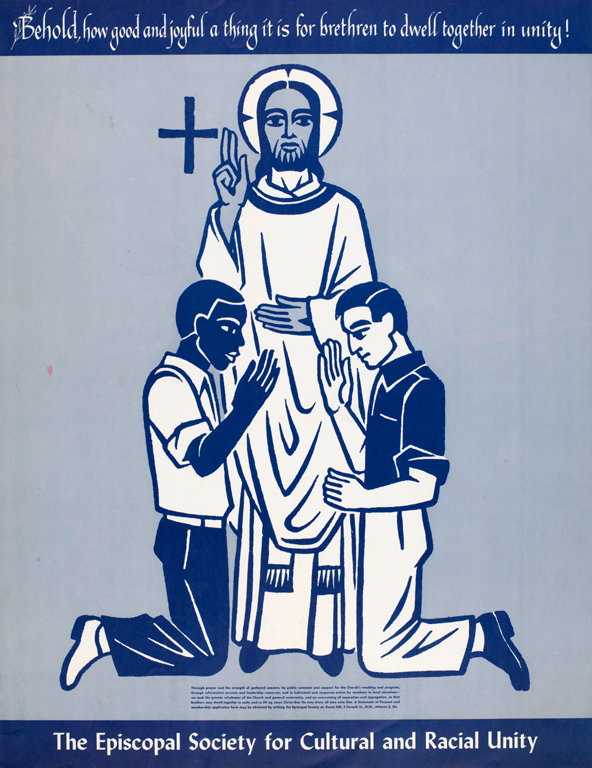
| Promotional Poster produced by The ESCRU (courtesy of the Virginia Museum of History and Culture) |
Even as early as the 1970s there was public scholarly documentation of the Bishop of New Jersey’s openly reactionary behavior in response to anti-racist organizing. John Kater’s 1973 dissertation[1] on “The Episcopal Society for Cultural and Racial Unity” (ESCRU)[2] provides a telling account of Bishop Banyard’s response to the organization in New Jersey.
Soon after its founding in 1959, the organization was based out of Atlanta. Priests in the Diocese of New Jersey were not among the first to work to affiliate with the ESCRU, with at least eleven chapters forming in other dioceses before the New Jersey chapter was attempted,[3] and much of the initial organizing oriented around southern segregation. The organization’s statement of purpose indicated that its goal was “to encourage men to respond positively to God’s call for unity in the Church,” which included “total participation in the Church for all persons without regard to race, class, or national origin; to give mutual support to all who act in this ministry of reconciliation; and to express this concern at parish levels and in a more creative witness throughout the community at large.”[4]
ESCRU was particularly committed to working against segregation and to “seeking the elimination of racial and other prejudicial barriers in society,”[5] and had a favorable reception from many bishops in the Episcopal Church. However, by 1964 the actions of the members of the New Jersey chapter had already drawn highly critical attention from Bishop Alfred L. Banyard. Kater writes: some episcopal authorities regarded ESCRU as an invasion of their jurisdiction and a threat to their leadership. Many of the southern bishops reacted in this way, as did the diocesan leadership in Long Island during the St. John's Hospital crisis. The Bishop of New Jersey was especially hostile to ESCRU's local efforts.[6] Kater describes the conflict in the following way: “In late 1964 and early 1965, a group of ESCRU members organized a chapter in the Diocese of New Jersey and elected Robert R. Spears, rector of Trinity Church, Princeton, as president. Spears wrote to the Bishop in February notifying him of their action. In response, Bishop… Banyard sent a memorandum addressed ‘To a Select Number of Our Clergy and Laity.’”[7] Banyard’s memo included the following accusation:
Not one single member of the Steering Committee or Officers or anyone else, including Spears himself, ever mentioned this to me…. Not one single clergyman ever mentioned the fact that they were plotting to establish this organization in my Jurisdiction…[8]
Kater goes on to state that Banyard “condemned”[9] what he described as Spears’ so-called “brazen and well-planned ignoring of [his] authority,”[10] and that in the memo Banyard similarly condemned “three resolutions proposed by the chapter to the Diocesan Convention”[11] that he deemed “highly controversial.”[12] These resolutions were, in fact, only aimed at providing support for “the Presiding Bishop’s Church and Race Fund, equal employment opportunities and Christian obedience.”[13]
While the ESCRU reception by the Bishop of New Jersey was not entirely without parallel, Kater does single it out as an extreme example of a negative episcopal reaction to the organization and its anti-racist aims. Kater’s history of the ESCRU is excellent reading and provides an important description of mid-20th century anti-racist organizing in the Episcopal Church. Though the organization experienced criticism for its mostly White leadership, and for not doing enough to platform Black voices in addressing the issue of segregation, the ESCRU ultimately helped birth other more effective and longer-established groups that carried forward the work of anti-racist organizing in the Episcopal Church, including the Union of Black Episcopalians.
Jolyon G. R. Pruszinski, Ph.D.
Reparations Commission Research Historian
Episcopal Diocese of New Jersey
[1] John L. Kater, Jr., “The Episcopal Society for Cultural and Racial Unity and its Role in the Episcopal Church, 1959—1970,” (PhD diss., McGill University, 1973): https://mcgill.scholaris.ca/items/0c9dcd81-30a8-4112-aa0d-ee4a815edb30.
[2] For more information see “Origins of the ESCRU” at https://exhibits.episcopalarchives.org/s/church-awakens/page/escru2.
[3] Kater, “Episcopal Society for Cultural and Racial Unity,” 96.
[4] The Episcopal Society for Cultural and Racial Unity, “Statement of Purpose,” 1: https://exhibits.episcopalarchives.org/files/original/c67873df02107f362f631727722d9e7d0cd584a8.pdf.
[5] The Episcopal Society for Cultural and Racial Unity, “Statement of Purpose,” 3.
[6] Kater, “Episcopal Society for Cultural and Racial Unity,” 97.
[7] Kater, “Episcopal Society for Cultural and Racial Unity,” 97.
[8] Bishop Alfred L. Banyard, Memorandum "To a Select Number of Our Clergy and Laity," April 19, 1965. As quoted in Kater, “Episcopal Society for Cultural and Racial Unity,” 97. MSS held at ESCRU archives at Emory University: https://archives.libraries.emory.edu/repositories/7/resources/2679.
[9] Kater, “Episcopal Society for Cultural and Racial Unity,” 97.
[10] Banyard, Memorandum.
[11] Kater, “Episcopal Society for Cultural and Racial Unity,” 97.
[12] Banyard, Memorandum.
[13] Kater, “Episcopal Society for Cultural and Racial Unity,” 97.
Monday, August 10, 2026
Banyard Disputes Concerns Over Collaboration with Openly Racist Levitt Corporation: A Letter to The Rev. Carter, on June 18, 1958
![]() |
| Rt. Rev. Alfred L. Banyard (photo by J. Pruszinski of portrait at Diocese of New Jersey, Trenton, NJ) & the Rev. Junius F. Carter, Jr. (Detail of "NAACP Million Dollar Campaign" (2021). B. L. Hooks Papers images. 648.) |
As protests over the proposed diocesan collaboration with the racist Levitt corporation began to grow, and the racist policies were reported in the national press,[1] Bishop Banyard responded to a letter of concern[2] from the Rev. Junius F. Carter, Jr. of St. Augustine’s Episcopal Church, Elizabeth to dispute the legitimacy of the concerns.
Firstly, in his greeting Banyard uses Carter’s first name with no honorific, unlike in the letter on the same subject[3] he had just written to a younger White priest he addressed as “Father Ralph.” Without preamble he delves straight into the matter at hand.
Banyard repeats the same arguments he had already rehearsed in that correspondence with the Rev. Ralph Lasher, “countless others who have written me,”[4] and apparently to the Rev. Kenneth MacDonald and Mr. J. Arthur Jones at a Board of Missions meeting the previous week. He claims that the policy of the diocese is only to have integrated churches, implying that any church built would thus inherently be integrated (ignoring the possibility of de facto segregation). In re-stating that the Levitt policy conflicts with state laws, he also suggests that the policy would not be possible to enforce, and was thus moot. And he further states that he will establish the church “if it is at all possible to administer to our people on an integrated basis.”
He goes on to suggest that because it has been difficult to garner support for the project across the diocese, that he believes that racial concerns will only be used as an excuse for non-cooperation by “recalcitrants.” He claims to be “just as indignant about segregation as… anyone else” but pointedly singles out “the colored” for the segregation he believes they practice themselves. He claims that he did not previously bring up this issue even though it “annoyed” him, but that now he brings it up in order to argue against what he claims is “an organized campaign… to oppose the establishment of a church in Levittown.” He asks that Carter “do something about that.”
He ends with further assurances that he cares about the issue and that Carter does “not need to worry about the stand of our Diocese of New Jersey and of your Bishop.” However, Banyard ultimately chose to cooperate with the Levitt corporation in spite of their policy of racial discrimination against Black people, worked to marginalize and de-legitimize protests against the collaboration, and denigrated those who had questioned the propriety of the partnership. In fact, contrary to his promise, he chose to establish the church even though the community it served was not integrated. The full letter to Carter[5] is presented below.
Jolyon G. R. Pruszinski, Ph.D.
Reparations Commission Research Historian
Episcopal Diocese of New Jersey
[1] E.g. in Tom Barrett, “N.J. Levittown Started; Negro Exclusion Stands,” New York Herald Tribune, June 8, 1958.
[2] “Junius F. Carter, Jr. to Alfred L. Banyard,” June 16, 1958. MSS held at Diocese of New Jersey archives, Trenton, NJ. See also Jolyon G. R. Pruszinski "St. Augustine’s, Elizabeth hesitant to Fund Building a Segregated White Church in Levittown: A Letter from The Rev. Junius F. Carter, Jr. to Bishop Banyard, June 16, 1958," DNJRJR (August 3, 2026):
[3] “Alfred L. Banyard to Ralph C. Lasher,” June 16, 1958. MSS held at Diocese of New Jersey archives, Trenton, NJ. See also Jolyon G. R. Pruszinski, "Banyard’s Intent to Build a Church for the Segregated Levitt Co. Development, and Contempt for Concerned Black Leaders: A Letter to the Rev. Lasher, June 16, 1958," DNJRJR (July 21, 2026): https://dionj-racialjusticereview.blogspot.com/2026/07/banyards-intent-to-build-church-for.html.
[4] This is likely a significant exaggeration.
[5] “Alfred L. Banyard to Junius F. Carter, Jr.,” June 18, 1958. Courtesy of the Diocese of New Jersey. MSS held at Diocese of New Jersey archives, Trenton, NJ.