 |
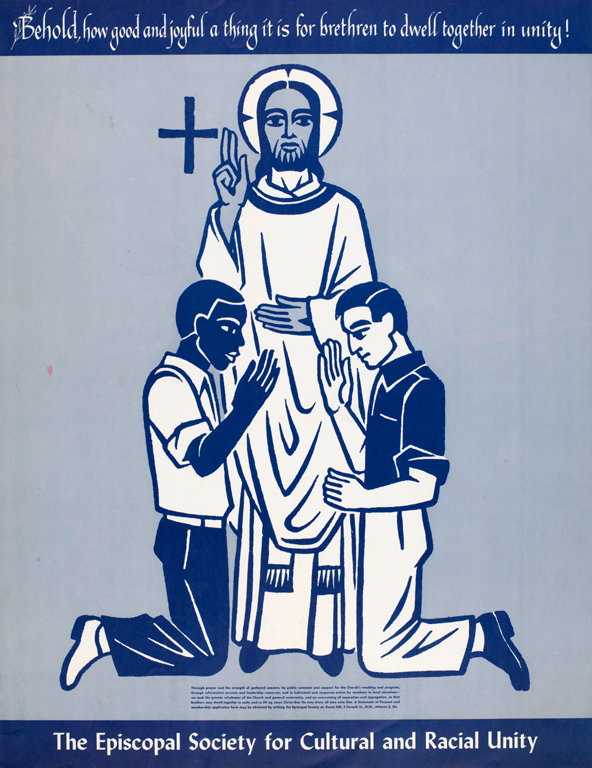
| Promotional Poster produced by The ESCRU (courtesy of the Virginia Museum of History and Culture) |
Even as early as the 1970s there was public scholarly documentation of the Bishop of New Jersey’s openly reactionary behavior in response to anti-racist organizing. John Kater’s 1973 dissertation[1] on “The Episcopal Society for Cultural and Racial Unity” (ESCRU)[2] provides a telling account of Bishop Banyard’s response to the organization in New Jersey.
Soon after its founding in 1959, the organization was based out of Atlanta. Priests in the Diocese of New Jersey were not among the first to work to affiliate with the ESCRU, with at least eleven chapters forming in other dioceses before the New Jersey chapter was attempted,[3] and much of the initial organizing oriented around southern segregation. The organization’s statement of purpose indicated that its goal was “to encourage men to respond positively to God’s call for unity in the Church,” which included “total participation in the Church for all persons without regard to race, class, or national origin; to give mutual support to all who act in this ministry of reconciliation; and to express this concern at parish levels and in a more creative witness throughout the community at large.”[4]
ESCRU was particularly committed to working against segregation and to “seeking the elimination of racial and other prejudicial barriers in society,”[5] and had a favorable reception from many bishops in the Episcopal Church. However, by 1964 the actions of the members of the New Jersey chapter had already drawn highly critical attention from Bishop Alfred L. Banyard. Kater writes: some episcopal authorities regarded ESCRU as an invasion of their jurisdiction and a threat to their leadership. Many of the southern bishops reacted in this way, as did the diocesan leadership in Long Island during the St. John's Hospital crisis. The Bishop of New Jersey was especially hostile to ESCRU's local efforts.[6] Kater describes the conflict in the following way: “In late 1964 and early 1965, a group of ESCRU members organized a chapter in the Diocese of New Jersey and elected Robert R. Spears, rector of Trinity Church, Princeton, as president. Spears wrote to the Bishop in February notifying him of their action. In response, Bishop… Banyard sent a memorandum addressed ‘To a Select Number of Our Clergy and Laity.’”[7] Banyard’s memo included the following accusation:
Not one single member of the Steering Committee or Officers or anyone else, including Spears himself, ever mentioned this to me…. Not one single clergyman ever mentioned the fact that they were plotting to establish this organization in my Jurisdiction…[8]
Kater goes on to state that Banyard “condemned”[9] what he described as Spears’ so-called “brazen and well-planned ignoring of [his] authority,”[10] and that in the memo Banyard similarly condemned “three resolutions proposed by the chapter to the Diocesan Convention”[11] that he deemed “highly controversial.”[12] These resolutions were, in fact, only aimed at providing support for “the Presiding Bishop’s Church and Race Fund, equal employment opportunities and Christian obedience.”[13]
While the ESCRU reception by the Bishop of New Jersey was not entirely without parallel, Kater does single it out as an extreme example of a negative episcopal reaction to the organization and its anti-racist aims. Kater’s history of the ESCRU is excellent reading and provides an important description of mid-20th century anti-racist organizing in the Episcopal Church. Though the organization experienced criticism for its mostly White leadership, and for not doing enough to platform Black voices in addressing the issue of segregation, the ESCRU ultimately helped birth other more effective and longer-established groups that carried forward the work of anti-racist organizing in the Episcopal Church, including the Union of Black Episcopalians.
Jolyon G. R. Pruszinski, Ph.D.
Reparations Commission Research Historian
Episcopal Diocese of New Jersey
[1] John L. Kater, Jr., “The Episcopal Society for Cultural and Racial Unity and its Role in the Episcopal Church, 1959—1970,” (PhD diss., McGill University, 1973): https://mcgill.scholaris.ca/items/0c9dcd81-30a8-4112-aa0d-ee4a815edb30.
[2] For more information see “Origins of the ESCRU” at https://exhibits.episcopalarchives.org/s/church-awakens/page/escru2.
[3] Kater, “Episcopal Society for Cultural and Racial Unity,” 96.
[4] The Episcopal Society for Cultural and Racial Unity, “Statement of Purpose,” 1: https://exhibits.episcopalarchives.org/files/original/c67873df02107f362f631727722d9e7d0cd584a8.pdf.
[5] The Episcopal Society for Cultural and Racial Unity, “Statement of Purpose,” 3.
[6] Kater, “Episcopal Society for Cultural and Racial Unity,” 97.
[7] Kater, “Episcopal Society for Cultural and Racial Unity,” 97.
[8] Bishop Alfred L. Banyard, Memorandum "To a Select Number of Our Clergy and Laity," April 19, 1965. As quoted in Kater, “Episcopal Society for Cultural and Racial Unity,” 97. MSS held at ESCRU archives at Emory University: https://archives.libraries.emory.edu/repositories/7/resources/2679.
[9] Kater, “Episcopal Society for Cultural and Racial Unity,” 97.
[10] Banyard, Memorandum.
[11] Kater, “Episcopal Society for Cultural and Racial Unity,” 97.
[12] Banyard, Memorandum.
[13] Kater, “Episcopal Society for Cultural and Racial Unity,” 97.
