Showing posts with label News. Show all posts

Monday, April 6, 2026

NEWS: "New York Diocese Outlines Plan for $1.2M Racial Reparations Fund" (RNS)


Reporter Fiona André of the Religion News Service (RNS) just published an article outlining recent developments in the Diocese of New York reparations initiative. The article is subtitled: "New York Episcopalians profited from the transatlantic slave trade and were ‘uniquely implicated in the odious institution and in anti-Black policies and practices that extend through generations,’ according to a new report." She writes:

The Episcopal Diocese of New York has launched the second phase of its racial reparations efforts, releasing a new report detailing how it plans to invest the nearly $1.2 million the diocesan convention began committing to the effort in 2019. The document, drafted by the diocese’s racial reparations commission and released publicly on March 17, describes a three-fold reparations process that is focused on: educating congregations about the diocese’s racist history; investing in Black communities in and outside of the Church; and pursuing reparations through a spiritual lens. It also makes recommendations on ways to sustain the reparations fund in the long term. “The report begins the next chapter of this work in a deepening of our commitment,” the Rt. Rev. Matthew F. Heyd, bishop of the Episcopal Diocese of New York, told RNS. “Our intention/commitment is to weave the recommendations of the report into the fabric of the diocese and into the whole of our ministries.”

For more information read the full article HERE.

Tuesday, March 31, 2026

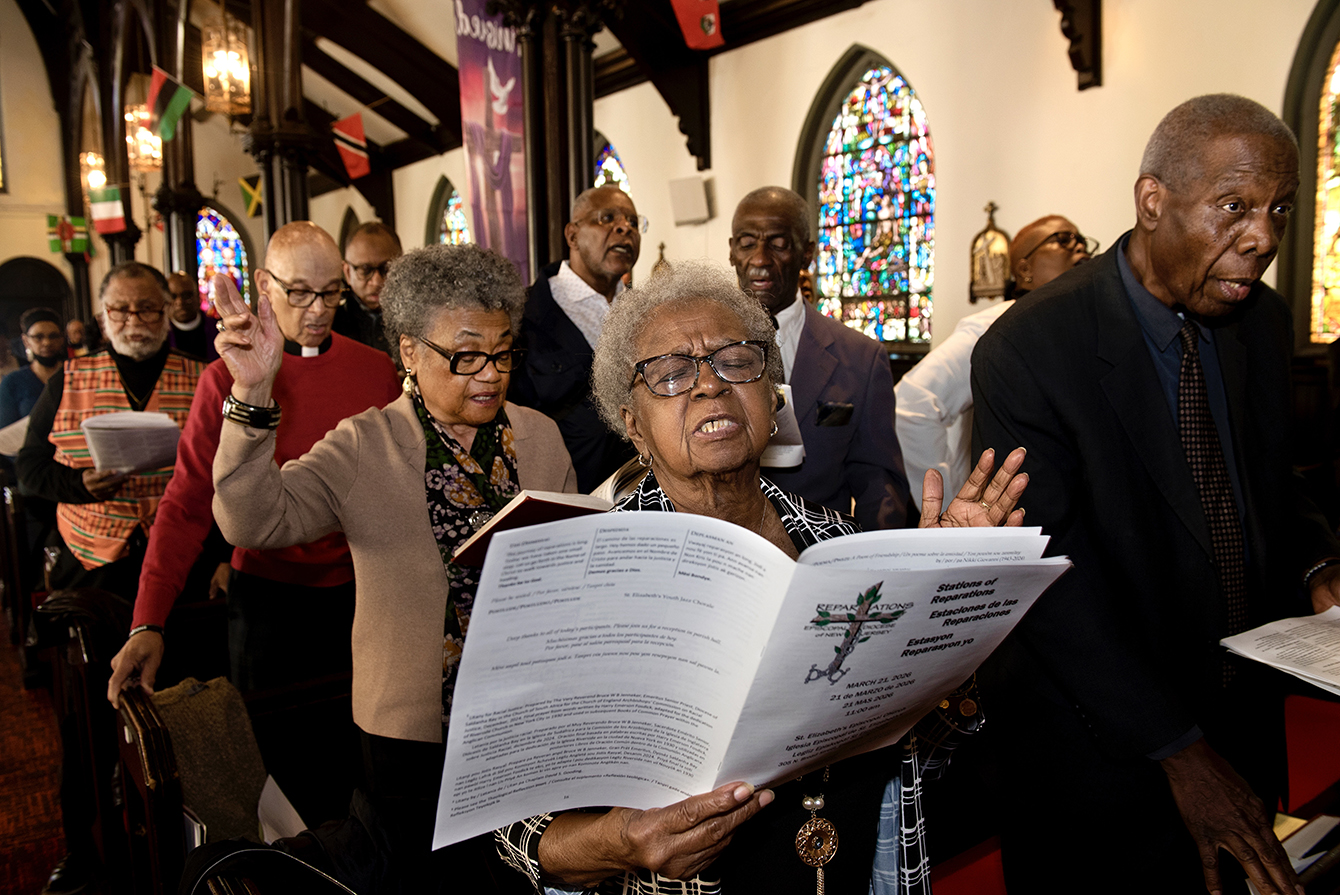
NEWS: STATIONS OF REPARATIONS HONOR BLACK CHURCH HISTORY

"Eugenia Wilson sings during the Stations of Reparations service
held at St. Elizabeth's Episcopal Church in Elizabeth, New Jersey."
Photo by Peter Tobia, courtesy Faith & Leadership.

Annette John-Hall, of Duke Divinity School's Faith & Leadership Journal, just published an article on the most recent Diocese of New Jersey Reparations Commission's Stations of Reparations Service which was held on March 21, 2026 at St. Elizabeth's Episcopal Church, Elizabeth, New Jersey. In the article, titled "Stations of Reparations honor Black church history" she writes: "The Episcopal Diocese of New Jersey pauses annually during Lent to reflect on the effect of systemic racism on its Black parishes. Along with acknowledging its own history, the diocese has worked for reparations at the state level with religious and secular organizations." To read more about the service, the historical research that goes into it, and the reparative justice initiatives that the Commission has been engaged in read the article for free HERE.

Monday, March 16, 2026

NEWS: "Southern Ohio is Latest Diocese to Commit Financial Resources to Racial Reparations Program" (ENS)


 The Episcopal New Service (ENS) recently published an article detailing the recent actions of the Episcopal Diocese of Southern Ohio on the subject of reparations. They report:

The Diocese of Southern Ohio has committed $500,000 as initial funding of a racial reparations program that parallels similar efforts in other dioceses, as The Episcopal Church continues to reckon with its historic complicity with white supremacy and racist systems. Southern Ohio Bishop Kristin Uffelman White announced her diocese’s reparations funding in a Feb. 23 news release, which explained money from a diocesan endowment fund would be used to support four historically Black congregations: St. Philip Episcopal Church in Columbus; St. Margaret’s Episcopal Church in Trotwood, near Dayton; St. Andrew’s Episcopal Church in Cincinnati’s Evanston neighborhood; and St. Simon of Cyrene Episcopal Church in Lincoln Heights, near Cincinnati. “This action does not indicate the completion of this work, nor the end of anticipated restitution of financial resources,” White said in the news release. “Rather, it marks an important first step in an ongoing process and demonstrates a meaningful financial commitment to reinvest in the vitality and self-determination of our Black leadership and communities.”

For more information read the full ENS article HERE.

Sunday, February 1, 2026

NEWS: Black History Month 2026 at DNJRJR

"Black History Month Design" by Marina Shemesh (License: CC0 Public Domain)

Welcome to Black History Month at the Diocese of New Jersey Racial Justice Review! To honor Black history this month, every day of February the DNJRJR will be sharing a Diocese of New Jersey Black history post on our Facebook page. Follow the page to make sure you don’t miss any (because let’s be honest, the algorithms don't really help)!


Jolyon G. R. Pruszinski, Ph.D.

Reparations Commission Historian

Episcopal Diocese of New Jersey

Tuesday, January 20, 2026

NEWS: Accurate Reporting Moves the Needle on Reparations in the Episcopal Church


In early November of 2025, Aleja Hertzler-McCain and Fiona André of the Religion News Service (RNS) published an in-depth article detailing the failings of the Diocese of Virginia to take meaningful steps to fulfill it pledge to dedicate $10 million to reparative justice efforts in light of its connections to enrichment through slavery. The article was titled "Four years after promising $10M for racial reparations, Virginia's Episcopalians have little to show" and was published following interviews with members of the diocesan reparations task force. The article began: "'I felt like we were kind of misled as a task force in terms of level (of) engagement,' said one member of a reparations task force of the diocese's efforts." It appears that the robust and honest reporting on the actions of the diocese, combined with the willingness of task force members to speak forthrightly to the press, had an immediate effect. Within weeks the Diocese of Virginia announced that it had determined sources of funding for the initial pledge. Before the end of November André and Hertzler-McCain were able to publish a follow-up article titled "Virginia's Episcopal bishop says diocese identified sources for $10M reparations fund" claiming that "The announcement came after former Racial Reparations Task Force members expressed doubts over the diocese’s commitment to deliver on its 2021 promise and uncertainty about its ability to secure funding." Other Episcopal groups working on reparations should take notice: accurate reporting and a willingness to speaking openly about institutional failings can move the needle in otherwise resistant or complacent institutional bureaucracies.

The full initial article detailing failings can be found HERE.
The follow-up article detailing developments can be found HERE.

Jolyon G. R. Pruszinski
Reparations Commission Research Historian
Episcopal Diocese of New Jersey

Wednesday, December 31, 2025

NEWS: San Francisco Creates Reparations Fund

In another success for reparations advocates, just before Christmas the mayor of San Francisco, Daniel Lurie, signed into law a local ordinance creating a reparative justice fund to address long-standing discrimination toward Black residents. According to recent reporting, the measure was approved unanimously by the San Francisco Board of Supervisors and comes on the heels of the release of the “San Francisco Reparations Plan 2023” produced by the San Francisco African American Reparations Advisory Committee and the San Francisco Human Rights Commission (SFHRC). The measure did not specify a total amount for the fund, but will enable contributions from various entities including institutions, individuals, and city funds. The fund will be governed by the SFHRC, and while the ordinance does not specify the fund disbursement recipients, it is expected that it will fund projects proposed in the 2023 report. Subsequent deliberations will determine details the size, nature, and recipients of funds.

Jolyon G. R. Pruszinski, Ph.D.
Reparations Commission Historian
Episcopal Diocese of New Jersey

Sunday, November 30, 2025

NEWS: Diocesan Convention Approves Formation of Reparative Justice Trust

Christ Church, Toms River, Location of the 242nd diocesan convention. 
Image courtesy of Episcopal Asset Map (edited).

The Diocese of New Jersey met for its 242nd diocesan convention on November 22, 2025 at Christ Church, Toms River. At the convention the Reparations Commission of the diocese put forward Resolution 242-5 calling for the creation of a dedicated diocesan trust for reparative justice and board of overseers. The resolution also called for the board to produce recommendations by the next convention of sources of funds to populate the trust, the target size for the fund, and additional necessary non-financial reparative actions. In spite of warnings from detractors that the diocese was not ready for such an action and would reject the resolution, we are delighted to report that it passed with near unanimous (over 95%) affirmation. Below are appended the text of the Resolution as passed and attendant published supporting documentation:

-----------------------------------

COMMITTEE ON RESOLUTIONS RESOLUTION 242-5 


Be it resolved, That the 242nd Convention of the Diocese of New Jersey direct Diocesan Council to establish a restricted trust fund for reparative justice to support Historically Black congregations harmed by practices of slavery and disadvantaged conditions resulting from slavery and centuries of systemic racism, to be designated as the Reparative Justice Trust Fund; and be it 

Further resolved, That the Bishop of New Jersey, in consultation with the Co-Chairs of the Reparations Commission and the Canon for Black Ministries, appoint a standing Reparative Justice Financial Board of not less than twelve members, to be composed of representative current members of the Reparations Commission, the Trustees of Church Properties, the trustees of the Diocesan Investment Trust, the Diocesan Council, the Standing Committee, and the Commission on Black Ministries, with the following terms of office: 

·       of those initially appointed, one third shall be given one-year terms, one third two-year terms, and one third three-year terms 

·       subsequent appointments shall be for 3-year terms, subject to reappointment, and provided that their successors shall be appointed from the then current membership of the Diocesan body from which the retiring member was appointed 

·       the Bishop shall appoint a Chair and any other officers of the Board from among its members; and be it 


Further resolved, That the Reparative Justice Financial Board identify sources of initial funds and procedures for contribution of additional funds that include contributions from organizations and individuals and, once such fund is established, be responsible for the granting and disbursement of funds to Historically Black Churches; and be it 


Further resolved, That the Reparations Commission work with the Bishop, Diocesan Staff, Diocesan Council, the Standing Committee, and other relevant persons to support transformative changes in processes and structures that need addressing beyond monetary compensation; and be it

Further resolved, That the Reparative Justice Financial Board report to the 243rd Diocesan Convention and annually thereafter with details on the target size, funding sources, and administration of the Reparative Justice Trust Fund. 

-----------------------------------


From 2025 Preliminary Report of the Committee on Resolutions” (pages 11-12):


Statement in Support of Resolution 242-5 by Proposers:


This resolution is an exercise in truth-telling done in the memory of the Christ who stands with the victims throughout history. The Rev. Dr. Kelly Brown Douglas asserts that reparations confirm our commitment as a Eucharistic community to anamnesis, remembering and celebrating the sacrificial love and solidarity of Jesus. The anamnestic truth-telling of this resolution “confronts the ways in which the past remains alive in the present, thus paving the way to right the present by exonerating it from contemporary vestiges of the past.” (Kelly Brown Douglas


The Reparations Commission of the Diocese of New Jersey has investigated the financial health of the Historically Black Churches (HBCs) and has also asked the church leaders what pressing challenges reparatory funds could address. The Commission proposes this resolution as a faithful and necessary step to acknowledge and address historic and ongoing harms caused by slavery and systemic racism. 


For centuries, HBCs in this Diocese have endured deep and compounding injustices. These com- munities have shown extraordinary resilience, faith, and leadership despite being materially and structurally disadvantaged by policies and practices rooted in white supremacy. This resolution seeks not only to offer financial redress but to affirm the dignity, contributions, and futures of these congregations. 


A recent survey of HBCs shows the following initiatives that could be addressed using reparative resources: 

·       Redevelopment of Property: The survey revealed that parishes have creative solutions to use large properties for the service of mission (i.e., community centers, affordable housing); 

·       Building Maintenance and Facility Upgrades: Parishes desire to make significant upgrades to ensure accessibility, improve space usage for hospitality, and implement state-of-the-art technology; 

·       Mission and Outreach: Parishes express hopes of expanding outreach efforts and partnerships with other community organizations, schools, and institutions to address systemic issues; 

·       Promote Spiritual Formation: The survey highlights that parishes wish to offer a broader range of faith formation. While there would be a focus on youth, programs would serve multi-generations; 

·       Expand Staff and Membership: A primary way is to ensure funding for dedicated clergy and to bolster parish support staff. The parishes were honest about the need to augment membership. 


A Reparative Justice Trust Fund represents a meaningful initial and ongoing commitment. This action aligns with our baptismal covenant to “strive for justice and peace among all people and respect the dignity of every human being.” It acknowledges our shared history while moving us closer to a more equitable and faithful future. 


The creation of a Reparative Justice Financial Board by the Bishop of New Jersey will ensure transparency, equity, and accountability in the stewardship of these funds. We encourage the Board to review a wide range of sources including a percentage of existing trust funds, a portion of the sale of new properties, and organizational or individual bequests. Furthermore, we affirm the critical role of the Reparations Commission in collaborating with diocesan leadership to address systemic change beyond monetary compensation, including how we structure ministry, share leadership, develop leaders for lay and ordained ministry, and uphold justice throughout the Diocese. This resolution is about truth-telling, healing, and transformation. Reparations are not about guilt but about responsibility. We take this step as followers of Christ, committed to the Gospel’s call to repair what is broken. 

-----------------------------------


Jolyon G. R. Pruszinski, Ph.D.

Reparations Commission Historian

Episcopal Diocese of New Jersey

Wednesday, October 29, 2025

NEWS: The book Anglican Slavery in New Jersey is out!


The new book Anglican Slavery in New Jersey: An Initial Accounting, based on research conducted through the Diocese of New Jersey Racial Justice Review by Reparations Commission historian Dr. Jolyon Pruszinski, is now available for purchase. From the book jacket: 
            “As the last northern state to enact gradual abolition laws, New Jersey played a powerful role in keeping slavery alive, and Anglicans and Episcopalians were deeply involved in establishing and maintaining that slave society. Throughout the colonial era, Anglicans were some of the strongest supporters of the institution, and often the most prolific enslavers, while formal church policy encouraged evangelization of the enslaved to ensure their docility. Priests stationed in the colony sought the “more comfortable subsistence” that plantation ownership provided, and many who became the most established in New Jersey succeeded as a result of their reliance on enslaved labor. After the Revolutionary War, White Episcopalians continued to be among those most resistant to changing slavery laws, and the initiatives they supported, such as the American Colonization Society and the 'Africa Mission,' were highly racist. Black Episcopalians who stayed with the Church during this time were marginalized through segregation and neglect, except when they were the victims of open hostility. In Anglican Slavery in New Jersey, Jolyon Pruszinski tells the neglected history that has shaped today’s church, and invites any who will hear to take up the work of research, reckoning, repentance, and repair.”

Sunday, August 31, 2025

Tuesday, July 1, 2025

NEWS: New Jersey Reparations Council Report RELEASED!

On Juneteenth, 2025 the New Jersey Reparations Council released its comprehensive report on the need for reparations in New Jersey: "For Such a Time as This: The Nowness of Reparations for Black People in New Jersey." The report covers a variety of relevant topics including the history of slavery and racism in the state, the current racial wealth gap, and the role faith organizations have played in slavery and racism. The entire report bears careful study, and should be read by all citizens of the state, but the recommendations for faith organizations are particularly relevant for the work of the Diocese of New Jersey Racial Justice Review

"Faith institutions have played a significant role in the history of slavery and its aftermath in New Jersey, both through complicity and resistance. The Council recommends that religious institutions across the state, including religiously founded schools and theological schools that benefited from slavery, engage in a statewide reckoning on reparations and pay restitution. These organizations have a profound moral responsibility to address the historical injustices from which they profited. Some denominations have already begun reparations initiatives to meet this moral responsibility; more should follow. Religious institutions that benefited from slavery should engage in conversations with Black faith institutions and Black congregations to facilitate a theological reckoning, reconciliation and restorative work towards reparations. Religious institutions should invest funds, including grants and endowments for buildings, in New Jersey’s Black religious institutions." 

We couldn't agree more. Thank you to the members of the New Jersey Reparations Council for your hard work and for the robust reporting.

Wednesday, May 14, 2025

NEWS: Smartphone Friendly Diocesan Slavery Pilgrimage Guide Released


Good News! You can now easily follow the liturgy for the Diocesan Slavery Pilgrimage on your smartphone. CLICK HERE for the pilgrimage liturgy guide in smartphone-friendly formatting.

Jolyon G. R. Pruszinski, Ph.D.
Reparations Commission Research Historian
Episcopal Diocese of New Jersey

Thursday, April 10, 2025

NEWS: Diocesan Slavery History Pilgrimage Featured in GNGS

The Diocese of New Jersey Reparations Commission Slavery History Pilgrimage was recently featured in the April 5, 2025 issue of Good News in the Garden State and was posted by the Diocese of New Jersey to its website. The weather is warming up, so now is a great time to go. Invite a friend, or your whole congregation! The pilgrimage guide can be found here.

Wednesday, November 27, 2024

NEWS: Recent Reporting on Reparations Polling Gets It Wrong

Recent reporting from the Daily Mail on reparations

In reporting seemingly designed to downplay the seismic shift underway in public opinion on reparations, the Daily Mail has claimed that the most important narrative to be told based on their recent polling is that not quite a majority of Americans do not support reparations for slavery. That many Americans do not support reparations for slavery is of course, not news, seeing as how that has been the majority position since the end of the Civil War. However, the real development masked by Daily Mail reporting is the increasing percentage of Americans who are not opposed to reparations. The newspaper’s own polling indicates that a majority of Americans are not opposed to reparations for slavery. This development follows on the heels of earlier polling (noted previously in the DNJRJR) which suggested that this was only the case for younger Californians. However, at this point it appears that public opinion in general may have shifted significantly among both older voters and even in other, less progressive states. In spite of the negative framing in Daily Mail reporting, supporters of reparations initiatives can be encouraged that by the apparently significant success they are having in winning supporters to their cause.

Jolyon G. R. Pruszinski, Ph.D.

Reparations Commission Research Historian

Episcopal Diocese of New Jersey

Tuesday, October 15, 2024

NEWS: Recent Episcopal Research on Racism Covered in ENS


Some good press for good research! Episcopal New Service just published an article highlighting the recent issue of Anglican and Episcopal History Journal which celebrates the 70th anniversary of the Brown vs. Board of Education decision by the U.S. Supreme Court in 1954. The ENS article describes the work that appears in this most recent issue, including multiple articles describing the history of integration in the church. This issue also features work from the Diocese of New Jersey Racial Justice Review. Enjoy!

Monday, September 23, 2024

NEWS: New Research at the Anglican Studies Seminar of the American Academy of Religion

Research from the Diocese of New Jersey Racial Justice Review will be featured in the upcoming Anglican Studies Seminar at the American Academy of Religion Annual Meeting in San Diego this November. The program will include papers examining “missiological currents within Anglicanism, past and present, that contribute to… Anglican identity formation and the ecclesiologies that arise alongside those identities." The Reparations Commission Research Historian, Dr. Jolyon Pruszinski will present “‘White Flight’ Missiology and Its Result: Racially Segregated Ecclesiology in the Episcopal Diocese of New Jersey.” From the introduction to his paper: 

Functionally speaking, the most recent burst of missionary effort and funding in the Diocese of New Jersey was the period of church planting and growth that occurred aimed at serving the massive suburban growth in the state in the mid-twentieth century. This period of development in the state has been characterized by urban planners as a period of “White flight” during which White families fled urban areas and settled in newly built, and (either formally or informally) racially restricted suburban developments in order to avoid proximity to Black neighbors. 

The Diocese of New Jersey fully cooperated with this pattern of development, often funding and building new churches in functionally racially restricted suburban areas. The construction of Christ the King, Levittown is exemplary: land was donated to the diocese by Levitt & Sons; A diocese-wide fundraising campaign ensued, which included the forced liquidation of the historically Black congregation of St. Monica’s, Trenton in order to use proceeds from the sale of property to fund building Christ the King; parishioners of St. Monica’s were instructed to attend other churches in the name of “integration;” only one of the several Trenton-area Episcopal churches offered a formal invitation to them. And while Christ the King began in the mid-20th century as exclusively White, once race-restrictions were overturned and Black neighbors moved in, most White families left the area and the church, and by the 1990s the diocese formally designated it a Black church.

Many urban Episcopal churches in the diocese during this period, such as in Trenton, Atlantic City, Elizabeth, and Camden, closed after being abandoned by White Episcopalians. Other formerly all-White churches in these areas were handed over to Black residents and have become Black churches (not unlike Christ the King). While the pattern of segregation in churches in the diocese partly dates to the Jim Crow era, during which the formation of a few Black churches was allowed rather than letting overt hostility from White Episcopalians “drive [Black people] to schism by cold neglect” (to quote Bishop Scarborough’s 1890 convention address), this pattern was further buttressed and cemented by the cooperation of diocesan authorities with the systemically racist patterns of development that were occurring throughout the state mid-century.

The result today is a significantly functionally segregated diocese, with Black churches located mostly in areas that have experienced decades of economic difficulty and systemic neglect, and White churches mostly located in areas that have been comparatively prosperous and fully supported with infrastructure and services. One of the results of this geographic pattern has been perennial underfunding of Black churches and ministries. Moreover, the relational and communication structure of the diocese has mirrored the physically segregated structure, with Black congregations siloed off from the rest of the diocese in many ways.

These current patterns of ecclesial organization in the diocese (racial segregation, respective location of thriving White churches and ailing Black churches, underfunded Black churches, siloed communication, etc.) appear to be, in part, the result of a long cooperation (on the part of the diocesan administration) with the prevailing patterns of systemic racism that produced the current, functionally segregated makeup of the state of New Jersey.


For more information on the upcoming Seminar see https://papers.aarweb.org/session/anglican-studies-seminar-session-1.

Wednesday, June 12, 2024

NEWS: Diocesan Reparations Commission Making the Case for Reparations

Figure 1: Commission Retreat participants, June 8, 2024: Dr. J. Pruszinski, W. Coleman, 
Cn. B. Bach, Rev. S. Sutton, Rev. P. Shoaf-Kozak, Cn. A. Buchanan, Rev. Cn. C. Sang, 
Rev. B. Rauen Sciaino, J. Gloster, Bishop S. French, J. Rodriguez (photo).

The Reparations Commission of the Episcopal Diocese of New Jersey, co-chaired by Canon Annette Buchanan and Canon Barbie Okamoto Bach, is actively making the case for reparations in the Garden State.
        In March the Commission organized its second Stations of Reparations, a Lenten service of repentance, which was hosted by St. Augustine's Episcopal Church, Asbury Park on Saturday March 16, 2024. Modelled on the traditional Stations of the Cross, the service focused on the Post-Civil War history of systemic racism in the diocese. The first Stations service, held in 2023, was the inspiration for the recent Province II collaborative service of repentance for slavery in which the Diocese of New Jersey was a participant. The March St. Augustine’s service featured testimony from members of Monmouth County Episcopal churches including Charles ​Hughes of St. Thomas’ Episcopal Church, Red Bank, Rev. Chase Danford of Trinity Episcopal Church, Asbury Park, and ​Linda Shomo of St. Augustine's Episcopal Church, Asbury Park, as well as testimony about the general history of racism in the diocese based on Commission research. The service was well attended, with dozens of churches from the diocese represented among the participants. The Commission is planning additional future services in other parts of the diocese.

Figure 2: Stations of Reparations Service, St. Augustine's Episcopal Church, Asbury Park, NJ, 
March 16, 2024 (Photo by Jolyon Pruszinski).


        On April 25, 2024, the Commission organized an educational reparations webinar, sixth in the "Journey Toward Reparations" series, subtitled “New Jersey's Opportunity to Learn from New York & California.” Guest speakers included New York State Senator James Sanders, Jr., the Reverend Charles Boyer of Greater Mt. Zion A.M.E. Church in Trenton, and the Reverend Dr. Darrell Armstrong of Shiloh Baptist Church in Trenton. The panel was moderated by the Reverend Charles Wynder, Jr., Dean of the Chapel at St. Paul’s School, Concord, NH. Co-sponsored by New Jersey Faith Allies for Reparations, a coalition of thirty-four  faith and social justice organizations with the single goal of convincing legislators to pass bills A602/S3164 to establish a state task force to study the case for reparative justice for the lasting harms of slavery, the webinar provided an excellent chance to hear from those who have been on the front lines of advocacy for reparations in state settings.
        Commission historian, Jolyon Pruszinski, Ph.D., preached at St. Luke’s Episcopal Church in Ewing, New Jersey for their April 28 Anti-Racism event sponsored by the St. Luke’s Black Lives Matter committee. He and co-convener Cn. Barbie Bach presented after the service to a packed room on the historic connection between Episcopalians/Anglicans in New Jersey and slavery and racism, as well as ongoing effects in the Church, and the role of reparations in repairing, restoring, and making amends for the historic wrongs of slavery and racism.
        May 23rd saw organization of the New Jersey Faith Allies Lobby Day at the State House in Trenton. Reparations Commission members are critical leaders in this movement and the Lobby day included direct engagement with over 20 individual legislators. Lobby day was followed quickly by a Rally Day on June 6th in front of the State House Annex. Participants urged New Jersey legislators to take action on the aforementioned task-force bills. Co-sponsors of the Rally Day included the League of Women Voters of New Jersey, the New Jersey Institute for Social Justice (NJISJ), the People's Organization for Progress, Asian American Pacific Islanders (AAPI) of New Jersey, and the Montclair Branch of the NAACP.
        The Commission retreat on June 8th saw Commission members connecting with and learning from Alexizendria “Zena” Link of the Diocese of Western Massachusetts, who has been intimately involved in the creation and organization of the Episcopal Coalition for Racial Equity and Justice (https://episcopalcoalition.org). This new non-profit entity, set up by the Episcopal Church's 80th General Convention as a voluntary association “dedicated to the work of becoming the Beloved Community,” will serve as a hub for “facilitating… supporting, and networking efforts of Episcopal dioceses, parishes, organizations, and individuals for racial justice and equity.”[1] A Reparations Commission exhibit booth at the General Convention in June will highlight diocesan racial justice efforts and provide an opportunity to network with other diocese pursuing racial justice while we await full operationalization of the Episcopal Coalition for Racial Equity and Justice.
        Commission activities in research, education, and organizing are ongoing. These include efforts to uncover and share the history of congregations in the diocese, preservation of the oral histories of African American lay and clergy people, and solicitation of the needs of historically Black congregations in the diocese in support of near-future resource commitments for reparations. This summer be on the lookout for forthcoming information regarding an in-state pilgrimage connecting various historical sites with the Episcopal Church’s history of slavery and racism. The Commission would also be happy to visit your church to present, preach, or support your racism research and reparative initiatives. Please contact Canon Annette Buchanan (email), Canon Barbie O. Bach (email), or Dr. Jolyon Pruszinski (email) to make arrangements.
 
Jolyon G. R. Pruszinski, Ph.D.
Reparations Commission Research Historian
Episcopal Diocese of New Jersey
Monday, June 10, 2024

NEWS: Boston Churches Planning Reparations Initiative

Figure 1: Trinity Church, Boston
(Gregg SquegliaCopley Square with Trinity Church and Hancock TowerCC BY-SA 4.0).

While the City of Boston has approved a reparations task force, and hired a team of researchers to conduct an initial historical study, White churches in the area have been asked to participate in the process of reckoning with their history with slavery and racism. The Boston People's Reparations Commission (an entity distinct from the City task force which includes various area church leaders), chaired by the Rev. Kevin Peterson, is in talks with some of Boston's historic White Churches to contribute financially to the reparations initiative. Included among the  churches in question are Arlington Street Church, Trinity Church, Old South Church, and King's Chapel. The Commission initiative is an important step toward recognizing that White churches that supported and benefitted from slavery have a reparative obligation beyond their own walls, and beyond the affiliations of their own denominations. Though some denominations have begun to take steps to consider reparative initiatives within their denominations, in many instances, those who were harmed are no longer (or never were) part of the churches that perpetrated the harm. Though many organizers expect the process of building a case for reparative action to be "a marathon," initiatives like those in Boston show that there is increasing traction in churches for addressing current inequities that have resulted from the historic injustices of slavery.

Wednesday, May 15, 2024

NEWS: The Church Pension Group Publishes Slavery Audit of Episcopal Church Funds


The Church Pension Group (CPG), which runs the pension funds for the Episcopal Church, has published the results of its recent audit of the historical links to slavery of CPG funds. The report can be found at the CPG website. Reporting on the release appears in the Episcopal New Service. The Church Pension fund endowment is one of the largest fifteen endowments in the world, and third largest if university endowments are excluded. The audit is a response to a general convention resolution calling for a forensic audit of the fund. However, the initial ENS reporting on the methodology employed in in the audit suggests that it is perhaps overly generous to suggest that it was "forensic." The researchers themselves admit that they did not research the majority of donors, ostensibly because their donations were small and it would have been a time-intensive process. That means that the official findings of "no" direct connection to slavery, and comparatively greater but still modest indirect links slavery, should be taken with a grain of salt. The producers of the study also readily admit that the donors were, almost without exception, White, and that the economic structures of society that enabled the accumulation of wealth by White Americans prior to and following the Civil War were deeply racist. As Patric Favreau, the Executive VP of CPG, noted (according to ENS reporting), "wealth accumulation for much of the 19th century cannot be separated from the economics of enslavement." This means that even as the overt connections to slavery discovered in the audit appear modest, the White wealth that provided the foundation for the Church Pension Fund, and its predecessor funds associated with the Domestic and Foreign Missionary Society, should be understood to be inextricably linked to racist processes of White wealth accumulation which functioned to prevent wealth accumulation by Black Americans.

Jolyon G. R. Pruszinski, Ph.D.
Reparations Commission Research Historian
Episcopal Diocese of New Jersey

Wednesday, May 1, 2024

NEWS: Stations of Reparations Service, St. Augustine's Asbury Park, NJ March 16, 2024

Figure 1: Stations of Reparations service, St. Augustine's Episcopal Church, Asbury Park, NJ, March 16, 2024.
Photo by Jolyon Pruszinski.

On Saturday March 16, 2024 the Reparations Commission of the Diocese of New Jersey sponsored its second annual Liturgy of Stations of Reparations, a Lenten service of repentance. Originally conceived by the Commission’s history working group, the service was a well-attended, broadly collaborative effort hosted by members of the influential, historically Black church, St. Augustine’s, Asbury Park, New Jersey. 
The first “Stations” service was held in March 2023 at St. Peter’s, Freehold, NJ, and brought together testimony from several churches that had researched their parish involvement with slavery. This second service focused on the Post-Civil War history of systemic racism and featured testimony from local Monmouth County Episcopal churches. This focus on systemic racism is itself rooted in New Jersey’s history of enslavement. A video recording of the service is available at https://www.youtube.com/watch?v=Z_AvkWiK8ks
The core of the service was modeled on the traditional Stations of the Cross, in which, at each Station, a portion of the story of Jesus’ Passion is told within a repeating structure of prayer. However, instead of featuring the stories of Jesus’ Passion, the service lifted up stories related to systemic racism and injustice, as well as achievement and lived faith in the context of historically Black congregations. Interspersed with presentations of parish histories were poems that fostered reflection on the Black experience of racism and a sung refrain from “There is a Balm in Gilead.” Dr. Bennett Craft (organ and piano) and Sheila Harris Jackson (soloist) led the music for the service, while the Rev. Dr. William Ndishabandi, Priest in Charge at St. Augustine’s, the Rev. Chase Danford, Rector of Trinity, Asbury Park, and the Rt. Rev. Sally French, Bishop of the Diocese of New Jersey, presided.
The first station featured testimony from Ms. Linda Shomo of St. Augustine’s, Asbury Park, past president of the New Jersey chapter of the Union of Black Episcopalians. She told about the recent history of racism in Asbury Park through an explanation of governmental development choices and their economic and social impacts. She further detailed her experience of the strained racial relationship between St. Augustine’s and Trinity, Asbury Park. Her moving descriptions of the nurturing parish life at St. Augustine’s that sustained her through the difficulties of growing up in a town beset by racism were a testament to the faithfulness and persistence of the congregation.
The second station’s historical presentation came from Rev. Danford of Trinity Asbury Park. He described some of the early racist laws in Asbury Park, and noted that the initial benefactor of the church, James Bradley, created many of these policies. He described modest early ministry to local Black people in the late nineteenth century, but also the lack of relationship with St. Augustine’s throughout the twentieth century. Lately Trinity has formed a Racial Justice Audit team to examine its history of racism. While much work remains to be done, Danford described new policies in hiring, improved relationships beyond the White community of Asbury Park, and the diversification of depictions of Jesus in the sacred art at Trinity.
The third station was presented by Charles Hughes of St. Thomas’ Episcopal Church, Red Bank whose wife’s grandparents were among the founding members of St. Thomas. That first generation began meeting in a chapel which had fallen into disuse which was then owned by the White congregation of Trinity Episcopal Church, Red Bank. In the mid-twentieth century, when St. Thomas had grown dramatically and looked to expand, many neighboring White residents sought to prevent their building. The congregation prevailed against this racist resistance and managed to build their new church in Red Bank in the 1950’s, continuing to bless the community that had resisted its presence. St. Thomas has had a thriving ministry there ever since, including founding “Lunch Break” (https://lunchbreak.org) a critical social service organization in Red Bank providing food, clothing, job training, and more to those experiencing financial insecurity.
The fourth station featured a description of the larger diocesan history of racism occurring following the civil war and throughout the twentieth century by Reparations Commission Research Historian, Jolyon Pruszinski, Ph.D. This racism included long-standing White refusal to worship with Black Episcopalians, underfunding of Black churches, and even the closing of Black congregations to fund White ones. Then, during a time of quiet reflection and prayer, participants were invited to consider the stories told by the presenters and possible steps the Holy Spirit might be prompting in response. The Rev. Kevin Thompson, Deacon, St. Thomas, Red Bank closed the service saying: “The journey of reparations is long. Today we have taken one small step. Let us go forth in the Name of Christ to walk towards justice and healing.” A hearty reception afterward, hosted by St. Augustine parishioners, allowed for continued conversation and the sharing of personal stories.
        The Commission believes it is essential that these stories be told in many ways, not least in the context of worship. Further services are being planned for other regions of the diocese in subsequent years, and many churches in the diocese are beginning to look into the ways they have participated in enslavement and engaged in or benefitted from racism. Updates from the Reparations Commission can be found at https://dioceseofnj.org/commissions/reparations-commission/ and research updates concerning the diocese’s history regarding slavery and racism can be found at the Diocese of New Jersey Racial Justice Review website: https://dionj-racialjusticereview.blogspot.com.

Jolyon G. R. Pruszinski, Ph.D.
Reparations Commission Research Historian
Episcopal Diocese of New Jersey