A Historical Self-Study by the Reparations Commission of the Episcopal Diocese of New Jersey
Tuesday, May 19, 2026
EVENT: Diocese of New Jersey Reparations Commission Slavery History Pilgrimage: Two Upcoming Opportunities (June 6 or July 18)
Thursday, April 30, 2026
Foreword by Elaine Pagels to "Anglican Slavery in New Jersey"
![]() |
| Jolyon Pruszinski and Elaine Pagels at Princeton University, May 16, 2024 (Photo by Molly Schneider) |
Professor of History of Religion, Princeton University
Sunday, April 26, 2026
VIDEO: REPARATIONS: A STATUS REPORT - FRONTIERS INT. PANEL APRIL 25, 2026
The Plainfield, New Jersey chapter of Frontiers International, one of the oldest Black service organizations in the United States, recently hosted a panel discussion on the state of reparations in New Jersey. The panel featured Dr. Jean-Pierre Brutus of the New Jersey Institute for Social Justice and New Jersey Reparations Council, the renowned organizer Lawrence Hamm, sociologist and congressional candidate Dr. Akil Khalfani, and Diocese of New Jersey Reparations Commission historian Dr. Jolyon Pruszinski. Frontiers has posted the video recording of the panel on their Youtube channel. Many thanks for the invite!
Monday, April 20, 2026
VIDEO: DIOCESE OF NEW JERSEY RESEARCH AT AHA WITH HSEC
The most recent newsletter from the Historical Society of the Episcopal Church (HSEC), The Clearinghouse, highlights research from the Diocese of New Jersey, with video! As part of a panel on reparations research and initiatives in the Episcopal Church organized by HSEC, the Diocesan Reparations Commission historian, Dr. Jolyon Pruszinski, presented on his recent research and the reparations initiatives in the Diocese of New Jersey at the American Historical Association (AHA) national conference in Chicago on January 10, 2026. The HSEC writes: "Watch a timely and important panel discussion, Anglican Slavery in New Jersey: Reparations Work in the Diocese of New Jersey and the Episcopal Church, available on the Historical Society’s YouTube Channel. Presented at the Annual Meeting of the American Historical Association in January 2026, this session brings together leading scholars and church historians to examine the complex legacy of Anglican involvement in slavery and the ongoing work of reparations within the Episcopal Church. Through thoughtful conversation, the panel explores how historical research is uncovering long-overlooked connections between Anglican institutions and slavery in New Jersey—and how this work is shaping efforts toward truth-telling, reconciliation, and repair today. Featuring: The Rev. Dr. Valerie Bailey (Moderator), Dr. Jolyon G. R. Pruszinski (Princeton University), The Rev. Dr. Sheryl Kujawa-Holbrook (Historiographer of the Episcopal Church). The discussion highlights the vital role of archival research, institutional accountability, and theological reflection in advancing meaningful reparations initiatives." Many thanks to Matthew Payne of the HSEC for producing the video of the event, and to Drs. Bailey and Kujawa-Holbrook for the invite!
Monday, April 6, 2026
NEWS: "New York Diocese Outlines Plan for $1.2M Racial Reparations Fund" (RNS)
Reporter Fiona AndrĂ© of the Religion News Service (RNS) just published an article outlining recent developments in the Diocese of New York reparations initiative. The article is subtitled: "New York Episcopalians profited from the transatlantic slave trade and were ‘uniquely implicated in the odious institution and in anti-Black policies and practices that extend through generations,’ according to a new report." She writes:
The Episcopal Diocese of New York has launched the second phase of its racial reparations efforts, releasing a new report detailing how it plans to invest the nearly $1.2 million the diocesan convention began committing to the effort in 2019. The document, drafted by the diocese’s racial reparations commission and released publicly on March 17, describes a three-fold reparations process that is focused on: educating congregations about the diocese’s racist history; investing in Black communities in and outside of the Church; and pursuing reparations through a spiritual lens. It also makes recommendations on ways to sustain the reparations fund in the long term. “The report begins the next chapter of this work in a deepening of our commitment,” the Rt. Rev. Matthew F. Heyd, bishop of the Episcopal Diocese of New York, told RNS. “Our intention/commitment is to weave the recommendations of the report into the fabric of the diocese and into the whole of our ministries.”
For more information read the full article HERE.
Tuesday, March 31, 2026
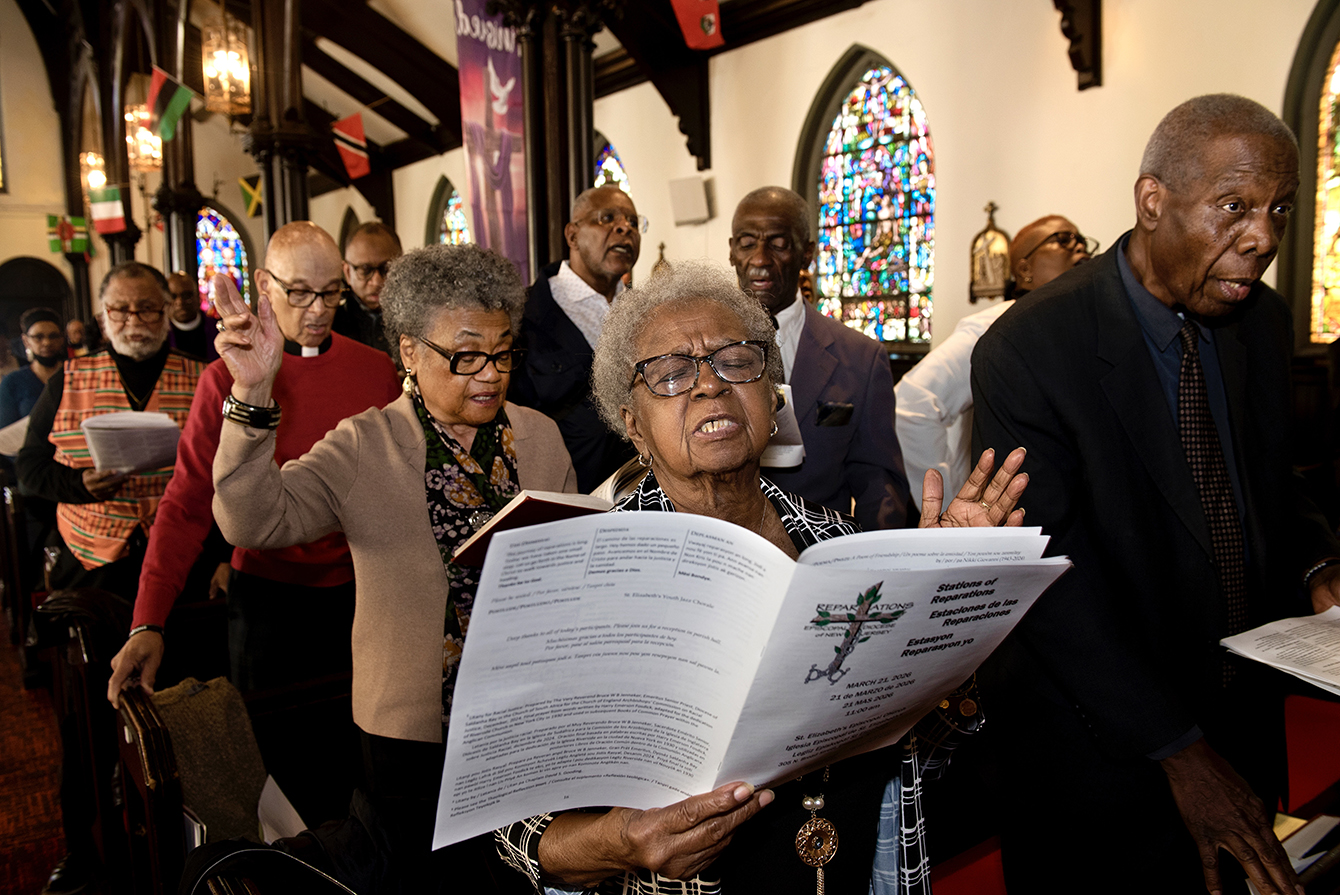
NEWS: STATIONS OF REPARATIONS HONOR BLACK CHURCH HISTORY
![]() |
| "Eugenia Wilson sings during the Stations of Reparations service held at St. Elizabeth's Episcopal Church in Elizabeth, New Jersey." Photo by Peter Tobia, courtesy Faith & Leadership. |
Annette John-Hall, of Duke Divinity School's Faith & Leadership Journal, just published an article on the most recent Diocese of New Jersey Reparations Commission's Stations of Reparations Service which was held on March 21, 2026 at St. Elizabeth's Episcopal Church, Elizabeth, New Jersey. In the article, titled "Stations of Reparations honor Black church history" she writes: "The Episcopal Diocese of New Jersey pauses annually during Lent to reflect on the effect of systemic racism on its Black parishes. Along with acknowledging its own history, the diocese has worked for reparations at the state level with religious and secular organizations." To read more about the service, the historical research that goes into it, and the reparative justice initiatives that the Commission has been engaged in read the article for free HERE.
Thursday, March 26, 2026
St. Peter's, Perth Amboy: Stations of Reparations Address, March 21, 2026
St. Peter’s Episcopal Church, Perth Amboy
Stations of Reparations Service, March 21, 2026
Held at St. Elizabeth's Episcopal Church, Elizabeth, NJ
Based on the address delivered by Louis E. Gumbs, Jr.
Edited by Jolyon G. R. Pruszinski
Hello everyone, my name is Louis Gumbs and I am here representing St. Peter’s Episcopal Church in Perth Amboy, New Jersey. St. Peter’s is the oldest church in the Diocese of New Jersey. It was founded in the late seventeenth century and was very influential in the growth of the Church in New Jersey.
Because it is such an old parish St. Peter’s has a long and complicated history with racism. For over one hundred years, Perth Amboy was the primary location for importing enslaved people into New Jersey,[1] and even the very positive parish history book written over eighty years ago acknowledges that in the colonial era all of the White Anglicans who went to St. Peter’s were enslavers.[2] But even from this early time Black people were considered part of the church.[3]
As the gradual emancipation of enslaved Black people slowly changed race relations in New Jersey up to the time of the Civil War, some free Black people worshipped at St. Peter’s. Among them was Thomas Mundy Peterson, the first Black man to vote in New Jersey following the enactment of the fifteenth amendment. The state holiday celebrating his life is actually less than two weeks away, on March 31.[4]
So St. Peter’s has welcomed Black congregants for much of its long history, but not always on equal terms. For many years there was a separate Black mass, and Black people had to sit in the back of the church during integrated services. In the early twentieth century this was actually significantly more welcoming than some neighboring Episcopal churches, like Christ Church, South Amboy and Trinity, Woodbridge where Black Episcopalians were not welcome at all.[5]
But even this partial integration was inadequate for the Reverend Canon George Hogan Boyd, the priest who came to St. Peter’s in 1935 and faithfully served the parish for four decades.[6] Soon after his arrival Canon Boyd insisted on full integration. No longer would there be separate Black services, or separate Black seating. Under his leadership Black parishioners were treated as full members of the church.
Following this change Black parishioners were elected to the vestry.[7] Black aspirants to the priesthood like Carlton Hazell were sponsored for seminary education as early as the 1940s.[8] Members of the parish fondly remember Canon Boyd for buying skates for the Black children of the parish and taking them ice skating.[9] Parish photographs and promotional materials from the 1950s show full racial integration of the life of the church.[10]
![]() |
| Detail of church leaders of St. Peter's, Perth Amboy, 1958. From Executive Committee, St. Peter's Building Program, 6. Photo by Ernest Jones. MSS held at St. Peter's. Used with permission. |
But it was not all easy or simple. At the time that Canon Boyd insisted on full integration, a significant number of White parishioners left to join an all-White Episcopal church in Perth Amboy.[11] There is a story about St. Peter’s told by Father Rod Croes that the last excommunication allowed in the diocese occurred at St. Peter’s when a member of the lay leadership refused to cooperate with integration.[12]
But it was during this time in the nineteen-fifties, when I was a child, that my family joined St. Peter’s. My father had been raised Anglican on the island of Anguilla and had heard about how welcoming Canon Boyd was. And that welcome has been my experience at St. Peter’s.
Growing up in Perth Amboy, segregation was not obvious to me. It was only after I went away to college, and experienced overt racism, that I began to be able to see the subtle ways that Perth Amboy was still segregated and, at times, racist. But over time that began to change. Canon Boyd was part of that too. He was deeply involved in the community and successfully worked to integrate the YMCA and other organizations. Even when chapters of the Episcopal Youth Organization from other churches were not happy that our integrated chapter participated in diocesan events, he supported us and there was never anything from him but nurture. Because of his influence, he set the tone for equality and welcome at St. Peter’s.
Over the years my extended family has been involved both at St. Peter’s and at St. James AME church in Perth Amboy. The relationship between these two congregations has been an organic product of family connection and welcome. But even in spite of long years of relationship and support there have been challenges. When St. Peter’s called its first Black woman priest about fifteen years ago, the Rev. Dr. Anne-Marie Jaffrey, a few people left because they didn’t want a Black priest.[13] But those who remained have continued the tradition of welcome and equality.
Perth Amboy has changed a lot since the fifties and has become majority-Hispanic.[14] St. Peter’s has worked to adapt and welcome Hispanic families as well, including through Spanish language services starting under Father Rod and now with the help of Father Villalobos. I’ve served in leadership on the vestry and as warden since 2011. I’ve experienced racism in my professional life, often as the only Black employee at elite firms, and I’ve experienced racism at times in my community, but St. Peter’s has been a place where I have always felt welcome and equal. For the first time in our history we currently have Black parishioners serving as both Junior and Senior Warden. I’d like to think we keep the spirit of Thomas Mundy Peterson alive at St. Peter’s, insisting on the equal place of Black people both in our society and in the Episcopal Church.
[1] See Jolyon G. R. Pruszinski, “Perth Amboy Ferry Slip: A Site of Memory,” DNJRJR (15 July 2024): https://dionj-racialjusticereview.blogspot.com/2024/07/perth-amboy-ferry-slip-site-of-memory.html.
[2] William C. McGinnis, History of St. Peter’s Church in Perth Amboy, New Jersey 1685-1956 (Woodbridge, NJ: Woodbridge Publishing Co., 1956), 71.
[3] According to the very hagiographic history of the parish, “St. Peter’s church schools even before the Revolution provided for the secular as well as the spiritual education of Negro children.” McGinnis, History of St. Peter’s Church in Perth Amboy, 71-72.
[4] See “Joint Resolution No. 1,” https://pub.njleg.gov/bills/9899/pl98/1001_.htm, and Office of the Mayor, “Perth Amboy Celebrates the 153rdThomas Mundy Peterson Day,” https://www.perthamboynj.org/community/news/what_s_new/celebrating_thomas_mundy_peterson_day.
[5] Interview with Louis E. Gumbs, Jr. and Lisa Nanton, March 10, 2026. Conducted by Jolyon G. R. Pruszinski.
[6] See the obituary “Canon George Boyd St. Peter’s rector” in The News Tribune, Woodbridge, NJ (July 29, 1983). MSS held at St. Peter’s Episcopal Church, Perth Amboy.
[7] See vestry minutes from across the 1950s. MSS held at St. Peter’s Episcopal Church, Perth Amboy.
[8] See, for example, Minutes from “St. Peter’s Special Vestry Meeting – June 20, 1950.” MSS held at St. Peter’s Episcopal Church, Perth Amboy.
[9] A story relayed by the long-serving rector Fr. Rod Croes, retold in Interview with Louis E. Gumbs, Jr. and Lisa Nanton, March 10, 2026.
[10] Executive Committee, St. Peter’s Building Program (Perth Amboy: Modern Printing Industries, 1958). MSS held at St. Peter’s Episcopal Church, Perth Amboy.
[11] According to the recollection of family members of Louis Gumbs, Jr, retold in Interview with Louis E. Gumbs, Jr. and Lisa Nanton, March 10, 2026.
[12] Shared viva voce at the Watchung Clericus, March 12, 2024, at Calvary Episcopal Church, Flemington, New Jersey.
[13] Interview with Louis E. Gumbs, Jr. and Lisa Nanton, March 10, 2026.
[14] The city is now over 83% Hispanic according to the United States Census Bureau, “2020 Decennial Census Redistricting Data (Public Law 94-171),” published in 2021.