Friday, June 23, 2023

NEWS: Afterlives of Slavery Conference, OCT 19-21, 2023 in DC

This coming October 19-21, 2023 a consortium of research institutions will jointly sponsor an international conference in Washington, D.C. on the afterlives of slavery entitled "The Troubles I’ve Seen: Religious Dimensions of Slavery & Its Afterlives." The sponsoring institutions include Princeton Theological Seminary, Howard University School of Divinity, the Smithsonian National Museum of African American History and Culture, and the University of Liberia. More information on participation and attendance will be forthcoming shortly on the conference website


Among the papers presented will be findings from the Diocese of New Jersey Racial Justice Review, to be included in a paper entitled "Lex orandi lex servitutis: Slavery as Valorized in the Language of the Book of Common Prayer" to be given by Jolyon Pruszinski, the Diocese of New Jersey Reparations Commission Research Historian. Here is the paper abstract: 

"Christianity has a long history of valorizing languages of domination (e.g. “Lord,” “servant,” “slave,” “obedience,” “submission”), based partly on New Testament authors’ deployment of such language (particularly Pauline, and deutero-Pauline literature). However, in various Church settings this “slavish” language has been amplified well beyond its degree of usage in the New Testament. The American Book of Common Prayer (BCP), the primary liturgical guide for the worship of the Episcopal Church (TEC), is the product of such a setting, and exhibits dramatically more frequent usage of such language than does the New Testament. In the seventeenth century, the leadership of the Anglican Church came to view the practice of chattel slavery as salutary for the pecuniary benefit of the Church, Crown, and their faithful subjects. The Anglican Church both avidly contributed to the establishment of slavery in the American colonies, and sought to create a regime of obedience to the proper authorities, within which a valorized language of domination was particularly useful. The American BCP developed in a White context in TEC in which slavery was generally viewed as good, and dominating human relationships were viewed as appropriate. Through its continued use, the BCP reproduces such settings of domination, perhaps most troublingly, through the usage of Diaconate ordination vows which, in many circumstances, have required Black postulants to pledge servility to White bishops. The paper considers the contextual relevance of slavery for the development of the BCP and the afterlife of slavery perpetuated through its valorized language of domination."

Monday, June 12, 2023

Thomas and Carrie Fortune of St. Thomas, Red Bank

The Episcopal congregation at St. Thomas, Red Bank, New Jersey can look back to the influential couple, Thomas Fortune and Carrie Smiley Fortune for its modern founding as a Historically Black church (HBC). Both were born enslaved in the south and settled in the north as adults. In the late 1800's and early 1900's Thomas became a journalist, editor of The New York Age, and biographer of Booker T. Washington. He was perhaps the most influential African-American writer of the time, and was even responsible for popularizing the term "Afro-American." He was an organizer of the National Afro-American League, a forerunner of such groups as the NAACP. 

Thomas Fortune (Booker T. Washington, et al., Timothy Thomas Fortune 2,
marked as public domain, more details on 
Wikimedia Commons).

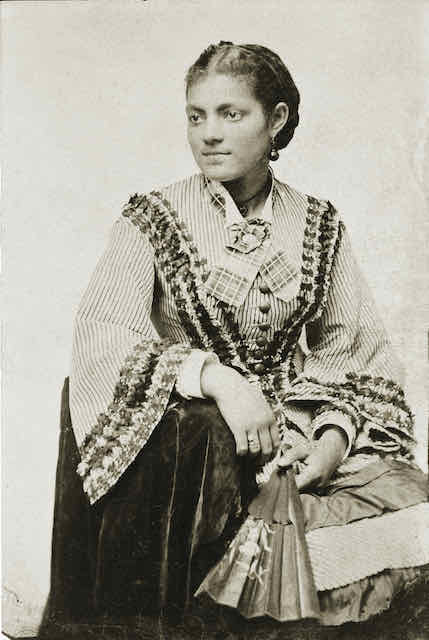
The couple eventually settled in Red Bank, New Jersey where Carrie was instrumental (starting in 1907) in convincing Bishop Scarborough of New Jersey to allow the use of the then defunct St. Thomas, Red Bank building for worship by an Episcopal African-American congregation, initiating the re-founding of the church. Carrie was also a founder of the National Urban League.

Carrie Smiley Fortune (courtesy Sag Harbor Historical Museum)

Today Red Bank is home to the T. Thomas Fortune Cultural Center which houses the Carrie Smiley Fortune Research Library, an initiative strongly supported by St. Thomas Episcopal Church, Red Bank. The fourth anniversary of the Library was recently celebrated in May 2023.

Link to more about T. Thomas Fortune at blackpast.org.

Link to a brief description of the lives of the Fortunes from the Sag Harbor Historical Museum. 

Link to the Carrie Fortune Research Library website and description


Thursday, June 1, 2023

Emancipated African-Americans Leaving the Episcopal Church: A Case Study from Middletown, NJ

 Emancipated African-Americans Leaving the Episcopal Church: A Case Study from Middletown, New Jersey


            Various historians have noted the attentions paid to enslaved Africans by the Anglican Church in colonial New Jersey.[1] In many ways the Anglican Church did more than most other denominations in the colonial period to evangelize, baptize, and worship with enslaved Africans. However this attention did not translate into widespread Black participation in the Episcopal Church once freedom had been gained. Key early Black Christian leaders in the region, like George White and John Jea, had exposure to Anglican worship and teaching but chose to affiliate elsewhere.[2] The Methodist split resulted in many Blacks with some Anglican background affiliating with the Methodists, and then subsequently with the African Methodist Episcopal Church once it was founded. Various independent Baptist churches also afforded a greater degree of freedom of worship for free Black Americans seeking religious self-governance and leadership opportunities.

While it is generally agreed upon by scholars that the majority of African Americans who had been exposed to Christianity through the Anglican, and later Episcopal, Church while enslaved did not go on to worship with the Episcopal Church after gaining their freedom,[3] there is limited documentary evidence available to establish many of the details of this phenomenon in New Jersey. Accurate accountings of such dynamics were not made reliably at the time and, in general, it is not the kind of phenomenon that received robust written documentation. However, an emblematic example for which we do have some documentary evidence is the experience of Charles and Hannah Reeves.

            In his recently published book Stories of Slavery in New Jersey, Rick Geffken describes the story of a Middletown, New Jersey couple, Charles and Hannah Reeves.[4] Charles had been enslaved by David Williamson, a well-to-do Middletown farmer. Reeves was freed at the age of twenty-five in 1848 under the New Jersey gradual abolition law. He married Hannah Van Cleif in 1850 at Holmdel Baptist Church. While Geffken suggests that it is not definitively known who Hannah’s enslavers were, the “Taylor family of Middletown had at least two slaves named Van Cleaf at their Kings Highway property.”[5] Geffken notes that “speculations about Hannah’s origins might be validated if a Williamson/Taylor nexus could be proved.”[6] That nexus is likely the mid-nineteenth-century lay leadership of the Christ Churches of Shrewsbury and Middletown.[7]


Christ Episcopal Church, Church Street and King's Highway, Middletown, Monmouth County, NJ
HABS NJ,13-MIDTO,2- (sheet 4 of 13)
, marked as public domain, more details on Wikimedia Commons
Published by the U.S. government as part of the Historic American Buildings Survey.


            As the archives of the Christ Church, Shrewsbury parish attest, David Williamson[8] and Joseph Taylor[9] both served in the lay leadership of Christ Church during this time, Williamson as a warden and Taylor on the vestry.[10] Though Hannah’s great-great-granddaughter, Mae Edwards, was never able to determine how the couple met, the Christ Church connection allows ample opportunity for Charles and Hannah both to have become acquainted. Moreover, the parish register of Christ Church, Shrewsbury paints a very disturbing picture of the treatment of enslaved Blacks while slavery was legal in New Jersey. The presence of myriad baptismal entries for enslaved “bastard” and “mullato” “servants”[11] shows that it was a common practice for the members in good standing at the church to rape their enslaved female domestics, and then enslave and baptize their progeny. This practice is widely attested in similar period documents, and as Geffken states, it was an “all too common occurrence at the time.”[12]

            These, and other facts suggest a particularly difficult experience during Hannah Van Cleif’s enslavement prior to her marriage. Geffken notes that her first child was born five years before her marriage to Charles, and that in the Reeves family Bible, this son, Isaiah, has no listed father, though all ten of Hannah’s subsequent children are stated to be children of Hannah and Charles. Hannah was likely enslaved when Isaiah was born; she was likely enslaved by Joseph Taylor; and during that enslavement she was likely raped.[13]

            Though Charles and Hannah Reeves were certainly exposed to Episcopal worship during their enslavement since the men who enslaved them were prominent members of the well-endowed Christ Church Shrewsbury/Middletown, upon gaining their freedom they did not worship in the Episcopal Church. There are any number of reasons this may have been the case,[14] and indeed there were likely many reasons -among them the likelihood of Hannah being raped by her well-regarded Episcopalian enslaver- but lack of piety was not one of them. All indications from the historical record suggest that Charles and Hannah were very pious.[15] Yet, when they were free to, they did not worship in the Episcopal Church, but in Baptist churches. They were married in Holmdel Baptist Church and later were founding members of Pilgrim Baptist Church in Red Bank. 

            While the story of Charles and Hannah Reeves is somewhat conjectural, the explanation described here is the most plausible option. Moreover, the experience of the Reeves couple is indicative of the patterns of experience of many Black Americans at the time. Many were exposed to Episcopal worship and teaching, but they were also exposed to Episcopal hypocrisy, mistreatment, and paternalism, and as such, comparatively few, when free to, chose to participate in Episcopal worship.  


Jolyon G. R. Pruszinski, Ph.D.

Reparations Commission Research Historian

Episcopal Diocese of New Jersey


[1] See Nelson R. Burr (The Anglican Church in New Jersey [Philadelphia: The Church Historical Society, 1954], 224-228) for an explanation that puts a very positive face on it. See R. E. Hood (“From a Headstart to a Deadstart: The Historical Basis for Black Indifference Toward the Episcopal Church 1800-1860,” HMPEC 51.3 [1982]: 269-296) for a more realistic accounting.

[2] See Graham Russell Hodges, ed., Black Itinerants of the Gospel: The Narratives of John Jea and George White (New York: Palgrave, 2002).

[3] See Hood, “From a Headstart to a Deadstart.”

[4] Rick Geffken, Stories of Slavery in New Jersey (Charleston, SC: The History Press, 2021), 82-98. Research into their lives was compiled by their great-granddaughter, Amanda Mae Edwards. Geffken’s book relates many of the elements of Edwards’ research.

[5] Geffken, (Stories of Slavery in New Jersey, 88) notes that there were various spellings of this same last name including Van Cleif, Van Cleaf, and Van Cleve.

[6] Geffken, Stories of Slavery in New Jersey, 88.

[7] The parishes were governed by a joint vestry and served jointly by a single priest for many decades until 1854.

[8] See also James Steen, History of Christ Church, Shrewsbury, New Jersey (Shrewsbury, NJ: Christ Church, Shrewsbury, 1972). David Williamson is celebrated yearly by Christ Church, Shrewsbury at their memorial observance.

[9] After the Shrewsbury and Middletown churches ceased to have shared leadership in 1854, Taylor continued to serve in Middletown (see, for example, the Diocese of New Jersey Convention minutes of 1855 and 1857, which show him to be a lay deputy from Christ Church, Middletown).

[10] Also Williamson was married to Phebe Hendrickson, with whose family Taylor was friends. See Joseph W. Hammond, “Orchard Home: The Story of a Gracious Residence, and of the People Who Lived and Worked There,” New Jersey Studies 5.1 (2019): 20, https://doi.org/10.14713/njs.v5i1.149.

[11] Parish register of Christ Church, Shrewsbury, N.J. See also Robert M. Kelley, “Slavery Evidenced in the Parish Register,” in The Crown (Shrewsbury, N.J.: Christ Church, Shrewsbury, 2018).

[12] Geffken, Stories of Slavery in New Jersey, 89.

[13] This theory accords with the educated guess of descendant John Smack that “most likely the slave owner… fathered Isaiah.” Geffken, Stories of Slavery in New Jersey, 90.

[14] See Jolyon G. R. Pruszinski, “The Revolutionary Period and Early Black Estrangement from the Episcopal Church,” Diocese of New Jersey Racial Justice Review, January 16, 2023.

[15] See, for example, the comments of John Smack, related in Geffken, Stories of Slavery in New Jersey, 90.

Friday, May 12, 2023

Slavery and Racism in the Episcopal Diocese of New Jersey: From Trinity Cathedral, Trenton

By Jolyon G. R. Pruszinski, Ph.D.

Delivered at ‘Til Earth and Heaven Ring, Evening Prayer Service

Trinity Cathedral, Trenton, New Jersey, May 7, 2023


The Episcopal Diocese of New Jersey has a long, and troubling history with slavery and the oppression of African Americans. It is a history that we White Christians can no longer hide from. We must be honest about it, admit it, and deal fully with its consequences.

From the very beginning of Anglican interest in colonial New Jersey, race-based chattel slavery was considered to be an integral part of the colonial project. Elite Anglicans set up the colony as a plantation economy dependent for its profits on enslaving Africans.[1] Many of the most prolific early enslavers were Anglicans like Governor Lewis Morris.[2] Many priests participated in this plantation economy and owned slaves themselves,[3] but the salaries for all priests sent to minister in colonial New Jersey were funded (in part) from the profits of Codrington Plantation in Barbados, where hundreds of Africans were kept enslaved.[4] Early draconian slavery codes[5] were successfully enacted by a group of influential Anglican legislators,[6] and Archbishop Tenison specifically worked to support provisions preventing baptism from being considered as a criterion for manumission.[7]


Attributed to Simon Du Bois artist QS:P170,Q12056662,P5102,Q230768,
 
Simon Dubois (attrib.) - Portrait of Thomas Tenison,
marked as public domain, more details on 
Wikimedia Commons


            The founding and establishment of the Anglican, and later Episcopal, Church in Trenton was made possible by a number of plantation owners, many if not all of whom enslaved Africans, including Gov. Lewis Morris, William and Mary Trent (for whom the city is named), the Tindalls, the Parkes, the Eatons, the Heaths, and Col. Daniel Coxe & family.[8] The Coxe family at one point laid claim to as many as 1 million acres of land in West Jersey, and Daniel Coxe was part of that Anglican ring of legislators that passed the early slavery codes. Coxe and his family enslaved many people and his son William was even a slave trader operating out of Philadelphia.[9] The Coxe family were major patrons of St. Michael’s throughout its first century.

After the Revolution, and the founding of the Episcopal Church, the first bishop of the Diocese, Bishop Croes, kept slaves.[10] The second bishop, Bishop Doane, was chosen to serve as bishop partly due to his wife’s personal wealth, as the diocese would not need to pay him. That very great wealth was derived from her first marriage to a man whose riches came directly from the slave trade.[11] Throughout this time slavery remained legal in New Jersey and in general the Episcopal Church did little to challenge it. Many wealthy Episcopalians enslaved blacks, and supported the confederacy during the Civil War. As is no doubt known to many here, legal slavery was only abolished in this state (except as a punishment for a crime) when the 13th amendment became law, superseding the New Jersey legislature’s initial rejection of the amendment. But slavery continued to cast a long shadow, and its presence in the prison system still has not been fully eradicated.

            After the war Bishop Odenheimer helped oversee the Freedman’s Commission, a weak northern Episcopal effort to aid newly emancipated Blacks, which only ever received very lackluster support.[12] The diocese essentially viewed itself as existing for the benefit of Whites,[13] with Blacks in some cases tolerated or allowed, but often only in segregated spaces and with limited opportunities. Jim Crow policies developed rapidly in the state following the war, and the Diocese generally went along with prevailing White attitudes.


Bishop William Odenheimer, by Hermon Griswold Batterson, marked as public domain, 
more details on 
Wikimedia Commons

Across the diocese during the mid-20th century, Episcopal Churches participated in white flight[14] from Trenton, Camden, and other urban areas, relocating churches for the convenience of white parishioners, without concern for the Black parishioners and Black communities left behind. White Episcopalians were among those who sat on the local planning boards that used New Jersey home rule legal precedents to keep African Americans out of their communities.[15] During this very era, the era of civil rights, church historians attempted to conceal this troubling history, straining to emphasize how much the Church loved Blacks,[16] when an impartial reading of the historical record could only have shown that such love was, in even the very best of instances, only half-hearted. If White Christians had truly loved their African American sisters and brothers, the Trenton riots of 1968 may never have happened. It seems it would be more accurate to say that the Episcopal Church had for the most part decided to be a chaplain blessing a racist White society, doing  little meaningful to challenge its depredations, and doing little to love and serve Black Americans.

In 1982, in the Historical Magazine of the Protestant Episcopal Church, African American historian and theologian Rev. Dr. Robert Earl Hood (later of General Seminary) wrote: “perhaps since the Episcopal Church cannot become a fit shepherd within the [B]lack community… it can adjust itself to being a perpetual servant in that community – a community of former servants. Perhaps… the Episcopal Church as an institution of former lords, can become a servant to the [B]lack servants of God.”[17] His words, written over forty years ago, are just as challenging today. There has been some movement, some faithful response, there has been some success, but the challenge has not been fully met. The challenge still stands.


Rev. Dr. Robert E. Hood, center. Courtesy St. Augustine's Episcopal Church, Gary, IN:
https://scalar.usc.edu/works/episcopal-diocese-of-northern-indiana-archives/rev-robert-earl-hood

Even so, even amid horrific structural obstacles, African American Christians (in New Jersey, in Trenton) have resisted oppression in all its forms, including oppression from their own churchly institutions. Our African American brothers and sisters have strived for faithfulness, even when relegated to the galleries of predominantly white churches. Even when treated with paternalistic condescension and neglect by White Diocesan authority structures. Even when treated as irrelevant by White decision makers looking to pull resources from Black neighborhoods to follow White congregants to White suburbs to build White churches. Even the success of our diocesan anti-racism training has been built on the hard experience of ongoing, active, living racism in our church.

Our Church’s history of wrongs haunts our present. Not just the African American present, but the White Christian present. If we are to make a better future, a better Church, a better Trenton, we can neither hide from our history, nor can we hide from our present. We cannot hide from our responsibility.

In the Mishnah,[18] Rabbi Tarfon is recorded as having said: “Do not be daunted by the enormity of the world’s grief. Do justly, now. Love mercy, now. Walk humbly, now. You are not obligated to complete the work, but neither are you free to abandon it.”


[1] As can be seen in the logic employed in Rev. Thomas Thompson’s The African Trade for Negro Slaves shewn to be Consistent with Principles of Humanity and with the Laws of revealed Religion (London: Baldwin, 1772).

[2] His mine at Tinton Falls accounted for approximately half of the enslaved Black population of Monmouth County at the time (Hodges, Slavery and Freedom in the Rural North, 12).

[3] Such as Rev. Samuel Cooke at Shrewsbury, who baptized his own enslaved Blacks, Rev. Thomas Thompson (as mentioned above), and Rev. Alexander Innes, unassigned priest resident in Monmouth County, owned a sizeable plantation (150 acres) which he managed via enslaved labor. A large proportion of the S.P.G. priests either owned plantations themselves (including at least Innes, Cooke, Beach, Vaughn, Skinner, and Lindsay) or received income from glebe or Church-owned plantation land (e.g. Blackwell, Ogden, Odell, Frazer) often worked by enslaved Blacks. Sporadic, brief references to these situations occur throughout Burr’s The Anglican Church in New Jersey. Rev. Thomas Haliday did not think the state of affairs adequate and suggested a more regularized and comprehensive plantation funding scheme employing enslaved Blacks to better ensure the comfort of the S.P.G. priests assigned to New Jersey (Burr, The Anglican Church in New Jersey, 132).

[4] See Travis Glasson, Mastering Christianity: Missionary Anglicanism and Slavery in the Atlantic World (Oxford: Oxford University Press, 2012), 141-70.

[5] Of 1704: See “An Act for Regulating Negro, Indian, and Mallatto Slaves within this Province of New Jersey,” December 12, 1704, in Bernard Bush, Laws of the Royal Colony of New Jersey, Vols. 1-5 (Trenton: New Jersey Archives, and Records Management, 1977-1986), 2:28-30.

[6] The so-called Anglican “ring.”  See Nelson R. Burr, The Anglican Church in New Jersey (Philadelphia: The Church Historical Society, 1954), 373-75.

[7] The administration of the Archbishop had drafted a law “For Converting the Negroes &c In the Plantations” which specifically stated that baptism did not in any way change the property status of a slave. This was sent to various authorities in the colonies to influence the legislative process. See “1st draught” in Lambeth Palace Archives, Gibson Papers, MSS 941, No. 72. Also Burr, The Anglican Church in New Jersey, 225.

[8] See Hamilton Schuyler, A History of St. Michael’s Church, Trenton (Princeton: Princeton University Press, 1926).

[9] See Darold D. Wax, “Negro Import Duties in Colonial Pennsylvania,” The Pennsylvania Magazine of History and Biography 97.1 (1973): 22-44, here p. 36.

[10] Bayker, Blakley, and Boyd, “His Name Was Will: Remembering Enslaved Individuals in Rutgers History,” p. 80.

[11] Eliza Greene Callahan Perkins had first been married to James Perkins, who was a wealthy slaveowner and slave trader. See “Harvard & the Legacy of Slavery,” (Boston: Harvard University, 2022), p. 22.

[12] See H. Peers Brewer, “The Protestant Episcopal Freedman’s Commission, 1865-1878,” HMPEC 26.4 (1957): 361-381.

[13] See, for instance, the tables and commentary on Church growth which appear in the back of The Anglican Church in New Jersey (pp. 467-485), which indicate Nelson Burr’s assumption that the Episcopal Church in New Jersey was a white-oriented institution.

[14] See oblique commentary in Burr, The Anglican Church in New Jersey, p. 476.

[15] This occurs to this day under the guise of objections to “affordable housing.”

[16] See Nelson Burr, The Anglican Church in New Jersey, pp. 224-228.

[17] R. E. Hood, “From a Headstart to a Deadstart: The Historical Basis for Black Indifference Toward the Episcopal Church 1800-1860,” HMPEC51.3 (1982): 269-296.

[18] This is a popular rendering of a few verses appearing in Pirkei Avot, commenting on that great justice text Micah 6:8. Quoted here from https://reformjudaism.org/beliefs-practices/spirituality/3-jewish-reminders-when-world-seems-overwhelming.

Thursday, May 4, 2023

NEWS: "California reparations panel OKs state apology, payments"

It has been recently reported that "California's reparations task force voted Saturday to approve recommendations on how the state may compensate and apologize to Black residents for generations of harm caused by discriminatory policies." In addition to recommendations related to financial reparation of over one million dollars per affected person, "The task force approved a public apology acknowledging the state’s responsibility for past wrongs and promising the state will not repeat them."

Tuesday, May 2, 2023

NEWS: "Stations of Reparations Liturgy" on Province II website


Christ Church, Shrewsbury liturgical participants (photo Dr. Jolyon Pruszinski)

A great summary of the recent Stations of Reparations Service at Christ Church, Freehold is now available on the Episcopal Church Province II website. Check it out!